The last post discussed floating the flop in detail and how to be successful with floats on multiple flops. It also talked about how you can "add outs" by representing some draws or specifically bluffing specific scare cards to create a bet frequency where you optimize your balance of bluffs to value bets and how doing so can allow you "extra outs" so that you can call even when you are drawing slim.
The sequel to the "float" is the "minibluff". While the float is a great idea, the "minibluff" is at times
better. The "minibluff" is like floating. But rather than just calling, you are minraising. Your opponent has to at least call, and probably will signal if he's best right there by raising or at least betting the turn. Assuming he just calls and THEN checks, passing up TWO chances to put in more chips, you have a bit more confidence than with a float that he is weak even though it cost you more to pull off. It should be a higher percentage play, particularly when you use sparingly and when the context of the move tells a believable story. So, you win more with your bluffs and they should succeed more often.
The reason you'd minibluff instead of float is if the flop is "semistatic" or a dynamic but without the type of draws on the board that you'd be too worried about. You might do this with a monster because you want the pot to get big enough that if a draw appears on the turn in addition to possible draws that exist now, you may want to inflate the pot such that you can shove the turn. You may also do it if opponent's bet on the flop is too small and a float would likely give him more reason to fire a second barrel. Conversely, you may also do it because you don't want to inflate the pot too much with a larger raise such that you can still get away from a ridiculous all in bet if one of a very select few number of cards hit the turn.
You also might occasionally minibluff if you have a longshot draw like a gutshot AND a backdoor draw. That way if you improve to a straightflush draw or double gutshot, or pair with gutshot or double gutshot flush draw, you might just take the free card if opponent checks. but almost always you will be following it up with a bluff on the turn and the success rate should be high enough to justify inflating the pot on the flop to win more with your bluffs.
You typically should make this type of bet if the chances the flop hit your opponent are slim, but the hands that do hit it are vulnerable anyways. The 279 flop for example particularly without 2 of the same suit is a flop that is extremely likely to have a Ten or Higher hit the turn but only a 12% chance at best for one of those cards to actually hit opponent on the turn. It is a connected enough flop where if you have a set you'd want to charge a hand like JT at least something for drawing and the bet isn't so large and it isn't likely enough that opponent has 68 or T8 or 45 to worry too much about an open ender or double gutshot draw. You are acting as if you HOPE opponent has A2,A7 or A9 or an overpair and falls in love with it enough to take the opportunity to get the money all in when in reality you are sometimes just looking for information and setting up a bluff. You probably are just facing a standard continuation bet with an opponent who doesn't play enough hands that connect with that type of flop very often at all. The float here doesn't make as much sense. Sure you could occasionally do it and try to take down the turn if an overcard to the board hits but there is more value in the miniraise against the standard weak Cbetting opponents, particularly if you have a tight enough image. This move is also how you might play a set trying to inflate the pot a little bit.
Your turn bluff need not be too large either. If pot was $600 on flop and bet was $300 and you minraise to $600 so that $1800 goes in before the turn, you might just bet $600-$800 on the turn. If opponent bet $200 in that $600 pot and you minraise to $400 so that $1400 goes in before the turn you might only bet $600 on the turn. You want a bet that screams "please give me action" because it probably is more effective than a large bet at this stage. However, if the turn card brings another connected card and/or potential flush draw, you might increase the bet to more of a standard bet of 2/3rds the pot or so.
The River is where when you DO have a monster and both the minibluff and turn bet were called, you will follow through with a very large bet. When you do NOT have a monster you need to follow the Optimal River Bluff To Value Bet Frequency method mentioned in the last post. You should somehow figure out given your hand range how often you'd behave like this and how often you'd hit the river or approximate enough to give you a good idea. And you have to make sure your monster is basically a lock against opponent's range at this point. If the bet is too small on the turn, some people may make a crying call particularly if they feel they may have outs with say A2 on the 279 board.
Not every play needs to be purely mathematical, particularly against opponents you will never see again, particularly if you have a good idea on how to exploit them without requiring this balance. If it is profitable enough to bluff don't worry that your bluffs and value bets don't balance. If it isn't, don't do it just to "create balance".
Another good type of flop to use the minibluff is on a low paired flop, particularly with connected cards like 556. If you had an overpair or 45 or A5 or 66 or A6 you'd want to make it difficult on a higher overpair to try to hit a two outer or make the ace king hands hard to hit. You might be somewhat worried about 78 or 34 or 47 or 23 or 89 or A2-A4 with backdoor flush draw and wheel draw or 67 with backdoor flush and straight draw but not worried enough to charge them a high price to draw. The story of minraising is consistent with how you might actually play monster hands in that spot or even very strong hands that you probably aren't folding, you want to get value out of the weaker hands and minraise to try to decide if you can get away from 45 or 77 or 88 if opponent shoves, but usually you're just trying to inflate the pot with a hand that is probably best right now while opponent may draw to 6 outs at best, but at worst he's drawing dead and putting in more money because it's only the minimum raise.
Now this kind of bet can be a pure bluff too or a semibluff that often times won't even be good if you hit so you don't mind being raised off of it, particularly if you have 89 or 23 for a gutshot or 34 for the idiot end of the draw. Any hand in your hand range is going to have overcards to the board and several pocket pair or an overpair. 22,33 and 44 are not only vulnerable to the overcards and current made hands but a 6 on the turn would counterfeit it and a running pair would as well so setting it up with that hand is fine. So while both you and your opponent may see a lot of value in any hand they have, they also will not like to call a large bet on the turn if they don't improve given the action you take of minraising the flop and continuing on the turn as if you've got something.
If the bluff fails, you can pretty much be done with it. But it should succeed often enough that it's actually better to minraise than to just flat call in these circumstances, or against an opponent who always Cbets and typically folds on the turn.
More importantly, if you float too often, it won't be as effective. Mixing in this move in with your floats along with some larger reraises on some flops to try to take it down there and possibly follow through on the turn will make you more dangerous and more challenging to play against.
The minibluff at it's best may even get opponent to fold for the lowest risk possible, but most likely will get opponent to make a crying call due to the odds you're offering him and because he doesn't want to make a habit of showing opponents he'll fold to a minraise, and most likely he will fold the turn.
A flop like JT7 may be a good flop to mnraise as well because you could have JT or 98 or JJ or TT or 77 but you would have to be slightly worried about KQ,QK,AQ and even 96 or 86. Still though, there are enough hands that flop hits like AJ and AT and A7 and even pocket 9's, 8's and lower that may call such a small raise and many of those may fold to a lot of turn cards. A large raise when you don't have 98 or JJ might only get hands that beat you to call. A minraise may make some sense here. It's a pretty difficult spot for say KJ to continue after the turn, AT and less will probably fold to that action on the turn except for a few stubborn opponents. AJ and QQ+ is difficult but most opponents would call. KQ may stick around and AK may get stubborn because they could have 4 or even 10 outs, and they have at least12 if they pick up a flush draw at some point.
A T76 flop or J87 type of flop would be a bit better since there's fewer hands to worry about and 45 isn't drawing to a higher straight and only J9 or J8 can outdraw you. You still can minraise either flop but you should probably miniraise to bluff much LESS often on a JT7 flop than on a T76 flop. Probably the minraise isn't the most logical and best play on the JT7 flop because it's a little bit too connected and a little bit too likely to hit opponent to where they may not fold, even with a line like this. Floating is probably not great either and reraising is difficult but perhaps makes sense against the right opponents. Playing a bit weak on these kind of flops and folding a lot is exploitable but isn't that big of a deal either.
J57 flop or Q57 is a good minibluff flop even if it's suited but stubborn opponents won't believe that story because it's a low percentage of your holdings and even AJ wouldn't necessarily play the hand that way and that's the kind of flop that you'd usually slow play. Even so, it's hard to call a bet on the turn knowing a big one could be coming on the river without at least SOME kind of hand like 88-TT or A7 or A5 or AK or AQ with a flush draw. A minibluff is slightly higher win rate than floating here, but floating may not be believed by some either because the pot will be smaller and you'll have failed to indicate strength on the flop. Weird spot because everyone plays jack high flops differently. Since I have fewer spots where I reraise large this may be a good flop to do so if I'm going to bluff. But minraise and floating aren't bad either. difficult to say what is best
Depending on preflop action there are a lot of Aj,Kj,Qj,JT,J9,J8 type of hands in opponent's range as well making it not the best spot to try to win a pot if you don't have to. Nevertheless, If I had to pick a play here knowing nothing else, the minraise would be pretty good.
Ten high flops and lower are pretty predictable and Q high flops and higher are pretty predictable. But opponents may or may not be concerned about K,Q, or A if they have JT. Other opponents might be. Some may believe floating is strength, others may think reraise on the flop is strength and others may think minraise.
9 high flops and lower with or without straights or flushdraws (but not both) are great spots for minibluffs as opponent has to be worried about a lot of overpairs, top pair ace kicker, any set and with that being said since most opponents play too many hands this is a spot where they will have to fold too often to continued pressure and so it will usually be more profitable to minibluff than to float.
Hands you should minibluff: Since you are representing extreme strength but also allowing opponent to see another card for cheap you either want a hand with no value at all or one with a very slim draw to the best hand in case opponent hits some rare other kind of draw or actually has a hand and elects to slow play since you've taken the initiative or because his hand is strong but he is afraid you may be stronger... That means you do not want a 45 with a flush draw but you want Ax with a flush draw or backdoor flush draw. You may also accept a backdoor flushdraw if it's a low card and has straight possibilities but the straight possibility has to be such that it wouldn't make a higher straight. 45s with 96 and any other card on flop isn't best since opponent could have 78 and your lower straight may not be good if opponent hits a 5 or T or opponent could have T7 or T8 or even JT and your running 78 wouldn't help.
Why a hand with no value at all? Why not a moderately strong draw and not usually a draw? Most draws should be played differently. Most draws you either want to scare away higher draws or you don't want to put any more money in where opponent won't fold and where opponent could raise you out of the hand at any time. You either want action from all very strong hands while raising the amount in the pot and building a big pot, or you want to look like you want action from all hands on the flop and building a big pot when really you're just trying to drag them a long and set up a bluff.
Even so, the action should be governed by the players first and the flop texture second and your recent history third and your actual hand should be only the 4th consideration.
Edit:
Minibluffing the turn to set up a river bluff: Since some players may think a minraise represents an attempt to buy a free card, the minraise may be more effective on the turn. It especially works if you check the flop as it represents a slowplayed hand, or nothing. But the minraise tells opponents it's probably a slowplayed hand. The minraise is often enough to deny most drawing hands the odds to draw with only one card to come, particularly if you have a set and they are drawing to a flush since the board could pair and give you quads or a full house. That doesn't mean they'll fold as they may think they have good implied odds.
When you are out of position you might tend to check low card flops more often since they favor the in position player. If opponent checks behind and you check again after another low card and opponent bets, he may be trying to pick up the pot. if you min raise and opponent just calls, this may be a good spot to follow through with a real bluff on the river to get opponent to fold his Ace King type hands and some lower and mid pocket pairs even.
When you are in position the play is far better, but you tend not to want to check low card flops very often. But say you check an ace, king, or queen high flop and opponent bets turn and you think he is likely to do so to try to pick up the pot. If you float the turn he may still follow through with medium strengthed hands and pure bluffs particularly if there is no ace on board or if a higher card comes on the river. So by showing strength here you get information. If opponent is strong and thinks you are strong he'll probably want to get the money in. If opponent is not strong he'll probably still call and be willing to give it up on the river often enough for it to be profitable to bluff.
This minibluff on the turn may also work if you floated the flop against a double barreler or have floated the flop a lot and opponents are starting to fire two bets and you have folded before to the second.
At some point in the future the minibluff on the turn after you bet the flop may work more effectively if players take the line of floating out of position and donk betting the turn.
The checkminibluff minraise is very tricky but can be more effective in representing strength. It's just akward for opponent to continue and so they may even fold the flop.
Tuesday, June 16, 2015

When to Float, Adding Outs, And Calling "way too often" Profitably
The Float is an advanced play which basically means not giving up so easily when you miss the flop. A "float" by default means an in position call with a hand that is usually 2nd best, if not "complete air" when you think opponent may also be weak. The reason you float has almost exclusively been used to bluff the turn. However, at times players have "double floated" both the turn and the river, or checked the flop, floated the turn and bluffed the river. Other times players who floated with the intention of bluffing will pick up a draw and prefer not check raising. Another tricky play is to float to represent a drawing hand and only bet if it hits, otherwise only stay in on the turn if you improve your hand or if you get a free river card.
If you are right about opponent having nothing, often times floating to "represent a draw" will allow you to see both the turn and the river for only a single flop bet if you are on a longshot draw like a gutshot or backdoor draw. This gives you extra equity on your bluffs on the turn if it fails and also gives you the option to occasionally check the turn so opponents can't easily check raise you off of good draws if you pick up a draw and since the draw is a longshot, you will often get paid off while you also may be able to bluff profitably if the draw hits.
Tournament poker edge has a good article on floating. However, I actually think it can be used more liberally, particularly if you play tight preflop such that you always play a strong preflop hand that has a greater than 50% chance of being best given the preflop action with a mixture of both low and high cards so you cannot be read.
It can be used liberally if you play looser than that preflop too but only if opponents do not play optimally or there are both antes and blinds.
Sidenote:Draw heavy boards and "dynamic" boards, especially both favor the in position player since there will likely be new information on each street that has a high chance of changing the strength of the hand no matter how hard you hit the flop. A straight can be vulnerable to a higher straight hitting their draw or a flush or board pairing to potentially make a fullhouse. A set can be vulnerable to a straight or flush.
On the Flop And Turn
It's important to know this river bluff to value bet ratio math does NOT apply on the flop and turn.**
If you are right about opponent having nothing, often times floating to "represent a draw" will allow you to see both the turn and the river for only a single flop bet if you are on a longshot draw like a gutshot or backdoor draw. This gives you extra equity on your bluffs on the turn if it fails and also gives you the option to occasionally check the turn so opponents can't easily check raise you off of good draws if you pick up a draw and since the draw is a longshot, you will often get paid off while you also may be able to bluff profitably if the draw hits.
Tournament poker edge has a good article on floating. However, I actually think it can be used more liberally, particularly if you play tight preflop such that you always play a strong preflop hand that has a greater than 50% chance of being best given the preflop action with a mixture of both low and high cards so you cannot be read.
It can be used liberally if you play looser than that preflop too but only if opponents do not play optimally or there are both antes and blinds.
I think there are actually 3 types of flops to float, but each of them must be approached differently to be used effectively, and they should not be done with just any hand you have, particularly if you don't have a good feel for opponents, they may not need to be done at all. But they can be done in a way that can add a LOT of balance to your play and difficulty to your opponents to put you on a hand.
1st)As the article describes a well defined board or "static" board (way ahead or way behind situations). The kind of board you'd slow play if you hit the flop.
AKK flop. AA8 flop or A88 or A82 with no flush potential. a 55J flop is pretty "static" but not quite as much Even jacks full on that flop is vulnerable to QQ hitting a 2 outer and A5 is vulnerable to any pair hitting a two outer as well as flush draws. A 552 flop is only "semi-static" since many hands like an overpair would probably still stay in and a high card on the turn could significantly change the equity in the hand.
But let's say we have a A88 flop.
If opponent has 99 it will be hard to continue knowing there may be multiple streets of betting. Whether you have KQ or 22 you can probably get opponents off the hand without an ace. As these flops are well defined, your hand doesn't matter on these really. Just the opponent and whether or not he has it. Either check/fold these flops if you miss or if you want to be tricky and difficult you can float. Call for information then either bluff the turn or give it up to a bet.
A call or fold is really the only play that makes sense on this type of board unless opponents have seen you 3bet with a monster before. If opponent checks you also should typically check these flops as a general practice and not continuation bet if you are in position. When you have a decent hand you want to get it to showdown without risking a lot. When you have a monster you want to let opponent catch up and when you have nothing you want it to look like you're slow playing so your bluff is more believable on the turn.
Side note: Well defined flops favor the out of position player since no card will provide information on how it helped opponent and so positional advantage doesn't necessarily apply and being the first in to bet or even double barrel bluff is more likely to be successful.
2nd) A draw heavy board
In this case the float is not designated as an automatic "bluff" on the turn but a strategic one that only develops if the board is likely to look scary to opponent's likely range of hands. If you do not actually have a draw, you are going to "float" the flop as if you do. If opponent checks you are NOT going to bet UNLESS it looks like you caught your draw. In addition to the possibility that you catch runner runner or maybe you pair one of your overcards to the board and have a chance at winning by showing the best hand, you also have more "outs" to a profitable bluff. If there are two cards of the same suit on board, there are 11 cards in the deck that would provide a potential flush. There is an over 20% chance that it hits by the turn and if opponent checks the turn you may see the river. There is over 40% chance that it hits by the river.
In the case of a draw heavy board you should either have a hand that is probably 2nd best but still has a chance of winning at showdown against AK... like 44 or 77 or 45 or 67 on a 56J flop, or a any type of draw, even a gutshot or longshot 3 cards to both a straight and flush like 45 of spades if there is both a spade and either a 2,3,6 or 7. Or if you have 46 of spades you need a spade and a 3,5 or 7 since you want the potential to turn an open ended draw at least. If another low card comes, your low pair may actually be good. But you still usually should still act as if you are playing the obvious draw since it doesn't probably seem to make sense to play AJ or QQ that way. An opponent who has Ace King may be stunned if you win at the river and stayed in for one or two bets post flop without a set, but what he doesn't realize is you were planning on bluffing much stronger hands than 44 out a good percentage of the time, and you only stayed until river because the opponent made the showdown cheap enough.
You are probably usually checking the turn on these boards even after floating the turn and you may be checking the river if you don't improve or you don't see a scare card. Depending on opponent you may bluff the river anyways if opponent checks again and isn't the type to check and call to bluff catch.
The strength of floating here is not being able to bluff as much as it is in getting a cheap showdown with a hand that still has a chance to win while mixing in SOME bluffs occasionally to make a slightly unprofitable call slightly profitable.
Sidenote:Draw heavy boards and "dynamic" boards, especially both favor the in position player since there will likely be new information on each street that has a high chance of changing the strength of the hand no matter how hard you hit the flop. A straight can be vulnerable to a higher straight hitting their draw or a flush or board pairing to potentially make a fullhouse. A set can be vulnerable to a straight or flush.
3rd) A not well defined board or "dynamic" board
If the board comes down ten high or lower with potential straights and flush draws (or ten high without them), the winning hand is probably not yet well defined. This benefits players in position as they have the ability to read opponent after conditions change. If a scare card to the board such as a higher card comes you can bet if opponent checks to you or bluff raise if he bets as it doesn't make sense that he would bet ten high flop and King turn unless he was just continuation betting the flop and hit one of his 6 outs. But if opponent is raised on the flop he will probably have to fold unless he has a king. So it's worth staying in. There are 16 cards in the deck that are scary for someone with T9 on 9 high flop. If one of these cards DONT come but opponent checks, you still should be able to bet some of the time and win against the opponents who Cbet AJ+,KQ,etc and give up on the turn. If one of those cards DONT come but opponent bets, you fold.
Hands to float:
Double back door draws.
You don't usually want to float without at least some chance of winning vs two pair. Regardless of flop, I like floating with 3 cards to a flush and 3 cards to a straight. This gives you as many as 27 cards that will at least give you 4 or 5 outs against most of opponent's hands on the turn. Even if you hit one of these cards you aren't that likely to hit the river, but you are likely enough where if you also can win pots often enough on bluffs and/or semibluffs and/or get paid off when you hit you may be able to turn this marginally unprofitable decision profitable, and you will tend to get action when you actually have a hand because you are mixing it up and staying in after the flop often enough to seem overly loose.
The bet has to be about half the pot or else I have to have a good feel for opponent.
On boards that do NOT have a lot of potential scare cards like ace or king high boards without obvious flush draws I will only float if opponent is a pretty ABC player who continuation bets or bets for information a lot but check/folds the turn a lot. I will tend to bet when checked to. If improve my draw to 8 outs or more on the turn, I will usually call an audible and take the free card to avoid being check raised and consider reserving my bluff for the river, or not at all. That way my opponent is likely to try to bet for value or bluff river and if I miss it only cost me a single flop bet call. If I hit my opponent will not be afraid of the straight or flush so he is more likely to pay me off. If I hit a low pair I often will also take the free card and consider calling a bet on the river if my opponent is aggressive enough to try to keep firing with ace high.
Floating on King or Ace or Queen high boards with a backdoor draw is even better when you can alsorepresent a different drawing hand like if you have 89 of spades and flop is T of clubs, 4 of clubs and 5 of spades. Depending how loose I've been playing, opponent could put me on 67, 36, 23,45,34,56 for a much better draw, or a club draw or even over cards.
If opponent has 22,33,66-99, T9, T8, AT,KT,QT or even JJ on a T45 flop, there's a lot of potential scarecards that could come that I could realistically act as if I had them.
This way, if the "float" fails and opponent bets I may have picked up a draw and have the odds to try to hit runner runner. I may be able to semibluff occasionally even. If the turn card is any club or any number of possible scarecards, It may be a good card to try to bluff. If opponent continues betting on a Ten high board and again on the Ace on the turn, his story short of having Ace King or Ace Queen and Cbetting doesn't make sense so I don't mind 3bet raising the turn after floating here but a particular scare card hitting is the only spot that I would consider raising on the turn after floating unless opponent was regular double barreler.
If you pick up a draw on the turn and opponent continues, you can still call even though you don't have the pot odds provided you try to bluff at a few rivers occasionally.
Hands To Float:
Middle Strength Hands
Middle strength hands can be floated with the idea that you are trying to check the turn and induce enough bluffs on the river to overall see a cheap showdown and possibly win the pot and you may add the occasional bluff in there in select spots as well, particularly ON the river itself if it will get enough higher middle strength hands to fold and it figures to be better than calling and is consistent with the story of either slowplaying or hitting a draw depending on what makes the most sense.
Many times you will have to float the turn only to give up at some point in the hand if the board increases it's overcards to your pocket pair from one to two or increase straight possibilities and/or flush possibilities or if opponent's action represents a high probability of having you beat where previously it did not.
If you are going to float with a pair the higher the pair the better. With 2 suits to a flush you may call a bit more often if you have a pocket pair that contain that suit because you can now semibluff the turn as if you hit the flush with outs if opponent doesn't buy your story, and if the board pairs or was already paired or if you hit your set you may have outs to full house if opponent just hit the flush.
If you are going to float with a pair on 3 cards to a flush you probably need an overpair like QQ or top pair with ace or king draw to the flush since you don't know if opponent has flush or draw to a higher flush with one or two overcards like AK to your QQ and you don't know if opponent already has flush and you are drawing or even if your outs are live. It's hard to get paid off if you hit and hard to avoid paying off opponent. Just calling is one way to get information, potentially give it up on certain turn cards (like an ace or a king and opponent still betting), and potentially see a fairly cheap showdown.
Hands To Float:Monsters - Of course you also will float with your monsters given the context of the flop. While most of the time two pair or any set is a monster on a 567 with 2 suits it is only a strong hand with dangers to the straight, flush, draws to straights or flush and higher two pair to your two pair or two pair to your set has outs, and non flush draws may have backdoor draw to flushes.
Conversely on a A72 rainbow flop or K72 flop, AK is a monster relatively speaking. There is no action killer coming and there is no card that really should scare you. Of course hitting trips or twopair without possibility of being counterfeited or hitting a fullhouse is usually a monster with very little chance opponent beats you or draws out.
Either top pair on a dry flop (maybe not always a monster) or an overpair on a dry flop is close enough of a monster to just call. Sometimes the turn will no longer allow you to slowplay but if you are going to float with air you also need to be floating with strong hands. Similarly, if you are going to check behind with strong hands you also should delayed continuation bet or delayed steal by checking and betting the turn on the same kind of flops.
Hands to Float:
Obvious Draws
Sometimes you will represent the obvious draws, and sometimes you will have it. Although sometimes you can bet and raise with the draws sometimes you should also call so opponents won't know what a call means. Are you drawing? Are you representing a draw and backdoor or gutshot drawing? Are you slow playing a monster? Are you slow playing twopair or better? Are you floating with air? Are you calling with a middle strength hand?
Hands to not float:
You can't always float or it will make the double barrel bluff too profitable for opponent. Of course, then you can mix in the double float but that complicates matters. Sometimes you need to play the hands aggressively, and sometimes just finishing the hand on the flop rather than small ball may be a better approach. Usually though you want to be aggressive with only your strong hands that stand up well against calls and reraises by opponents as well as bluffs since opponents have the ability to raise you off the hand when you have a draw or middle strength hand and if you get opponent to fold, you don't get any showdown value out of hands that may otherwise have some.
However, sometimes aggressively raising the worst of your "medium strength hands" will get other medium strength hands to fold where as not doing so would not. And sometimes when either stacks are deep enough to still show down or the aggression ends up with the all in types, your best of medium strength hands could be mixed in if opponents think your raises usually mean bluffs and he may accidentally give you value not only on monsters but on medium strengthed hands by calling with ace high type hands. Sometimes you need to get draws out yourself or you should just play the hand fast and semibluff straight away on the flop I used to obsess over floating but it's not that great of a move if everyone knows about it. On the well defined flops like AA8 you might occasionally play 22-66 fast as well as any ace, 88 and "bluff" hands like QJ which while it may seem pretty weak, on that flop it's actually the second highest non pair next to king high hands, may get lower pocket pairs to fold and still has outs to the "hero calls" players make with the low or mid pocket pair and should easily get any King hand of opponent to fold, but doesn't have enough show down value to really matter.
Adding Outs:
When you play certain draws there are other potential "scare cards". These "scare cards can in a sense be "extra outs" such that when they hit, you win if they are scary enough to get opponent to fold often enough for bet to profit.
Outs need to be added strategically and the story your hand is telling needs to make enough sense that opponent isn't likely to pick you off. If you play tight enough preflop it may be more conceivable that you could be slow playing a monster, and you will be often enough that your "floats" will represent strength a high enough percentage of the time that you may not necessarily need a "scare card" to hit.
Even still, in these situations you need a method to make sure you don't bluff too much or too little so you must be very calculated about it so that your play is mathematically correct enough to add value.
Optimal River Bluff To Value Bet Frequency
Based purely on mathematical game theory, if you are to bet half the pot on the river, you should try to increase your outs by 66.67% so that you bluff 40% of the time that you bet (if you have 8 outs you should "add" 5 outs and 1/3rd of the time on a 6th outs you may "add" a 6th out). If you are going to make a potsized bluff on the river, you have a bluff around 1/3rd of the time or increase the outs you have by 50% by picking out cards to bluff at. If you are going to make 2x pot bluff on river you should increase outs by only 33% so that you bluff 1/4 or 25% of the time that you bet. If you are going to make a 3x pot bet on river, 20% of the time you bet is a bluff, or increase outs 25%. The greater the hand you are drawing to, the larger the bet should be, provided opponents don't know that and can't just raise you off of your small bets. If your bets on the river when you have it are always the best hand, you should plan on betting the maximum and your bluff frequency should only increase by 1/ your stack size as a multiple of the pot plus 1.
9x the pot all in push means you only increase outs 1/10= 10% or bluff around 9% of the time that you bet.
Your opponent should call you such that your bluffs break even. So if the bet is a pot sized bet, opponents should call you half the time or with the top 50% of his hands he will have in that scenario. If the bet is 2x pot you can win the pot twice and lose the 3rd so opponent should have a hand to call you 1/3rd of the time. 9x opponent should call you 10% of the time.
With that theory comes the realization that if opponent will call you too often, you shouldn't bluff at all and thus probably shouldn't even call the turn unless the bet is 1/4th the pot or unless he'll call a big over bet if you hit. If opponent will fold to any scare card you might bluff more often and choose as many scare cards as he'll fold to. However, if opponent is good or you unknown, this is the "optimal" amount to bluff. So if you have 8 outs, pick 4 outs to bluff at as well on the turn if you are calling a bet and betting a pot sized bet on the river. You will bet the pot on 24% of river cards and so you can call a decent bet on the turn. If your bluffs break even, your made hands add value so you should win and get opponent to call the river's pot 50% of the time that you hit. So 50% of the river pot should be added in implied odds. So if you are facing a pot sized bet the river bet will be 3 times the turn and get called half the time or add 1.5 in added value. Rather than getting 2 to 1, you are gettin 3.5 to 1 and thus you only need to hit your "outs" 22% of the time. This seems ridiculous, but you can actually just barely call a pot sized bet with 8 outs on the turn and make money from that decision if you play this way.
Against opponents who fold too often, you can bluff a larger percentage of hands and should typically aim for smaller sized bluffs assuming they are still as effective since you are not looking to break even on bluffs against these opponents, but exploit and profit on bluffs.
On the Flop And Turn
It's important to know this river bluff to value bet ratio math does NOT apply on the flop and turn.**
On the flop and turn you should actually be staying in much more frequently in theory disproportionally to bet sized because of the ability for bluffs to make a hand, bluffs to be made on multiple streets and increasing bet sizes and either you or opponent being on a draw which may add for bluff opportunities and chances to win with hands that don't seem all that great on the flop. The average "optimal" frequency is staying in on some capacity in about 70% of all flops and 70% of all turns but that requires a much tighter preflop strategy and is far too often against most opponents who don't play optimally, and it requires creative ways for you to pick up chips such as using the river math to balance the bluffs and value bets, fight for equity in the hand and find ways to stay in strong.
**The only way it could apply is if you were pushing all in with your unbeatable monster hands where opponent cannot draw you out and you bluffed proportionally with pure bluff hands in the same manner that depended on the size relative to the pot. So if you pushed all in for 4 times the pot with an unbeatable monster hand, you need to add bluffs such that you increase your all in hand range by 20%. Thus if you calculated that an unbeatable monster flop made up 2% of all flops, you should have a pure "Mike Matusow Blow up" style bluff on 0.4% of all flops. How the hell you calculate that I have only the faintest idea** The alternative to "unbeatable hand shoves" is balancing the very longshot draw shoves in with roughly the same odds of drawing out to opponent's calling range. So if the monster shoves have an average of 85% equity against calling range, you need hands with 15% chance of winning vs the calling range. Then you can actually mix in those crazy drawing slim hands like bottom pair or gutshot provided you only do it the very small percentage of all flops you see to balance your monsters. Good luck with that.
Playing In The Dark: When You Can Raise With Any Two And Profit
There are some players that, once the antes are involved will literally raise with any two. A lot of people think that this strategy is crazy, but I want to show the math behind why in some spots this may actually be directly profitable. I want to talk about why this may be acceptable against a field that is incredibly weak and passive.
If opponents are too tight preflop you only need that bet to succeed 50% of the time and you can instantly muck when you are called or raised and still profit from raising with any two. You can profit if you pick up the blinds 50% of the time.
If you are only risking 2.25 big blinds and there are 2.25 in the pot from blinds and ante. If a steal succeeds 50% of the time, you are guarenteed profit as long as you don't put another chip into the pot if opponent calls and opponent occasionally checks to the river OR if the steal succeeds more than 50% of the time.
If a caller not in the blinds with blinds folding offers you 2:1 odds. This means you can lose 2.25x twice, win 5 on the third and break even. So if opponent always calls, your hand only needs to be best 33% of the time assuming it checks to the river and/or any other bets and steals offer no advantage to you or your opponent over time.
Raising with any two cards with 33% equity or more with antes involved makes sense. Raising with any two cards when you will pick up the blinds 50% or more is also profitable. But what if you have zero equity and multiple opponents? How often on average does each opponent have to fold? Or More applicable, what hand range or blind defense percentage do you need opponents to have to raise with any two?
Exploiting opponents in Antes Stages with raises:
If your raise range of any two vs calling range of opponents has zero equity when opponents don't fold, you can raise with any two if remaining players defend this often assuming you bet the amount in the pot:
8: All opponents each must play 8.2996% of hands or less to a raise for steal to be profitable.
7: 9.43% of hands or less.
6: 10.91% of hands or less.
5: 12.95% of hands or less.
4: 15.91% of hands or less.
3: 20.63% of hands or less.
Button: Steal profitable if blinds play 29.29% of all hands or less.
Small blind: Steal profitable if opponent plays 50% of all hands or more.
Big blind: Opponent must fold 50% of the hands he completes with or more.
If you have 20% equity when called (and all bets on and after flop break even), steal must succeed 35.56% of the time
Raise with any hand that has 20% equity if remaining opponents call this often or less:
8 12.13%
7 13.73%
6 15.83%
5 18.70%
4 22.78%
3 29.16%
2 40.37%*
1 64.44%*
If you have 30% equity when called (and all bets on and after flop break even), steal must succeed only 3.333% of the time.
Raise with hand that has 30% equity if remaining opponents call this often or less:
Hand % of opponents needed given X players remaining:
8 34.64%
7 38.49%
6 43.27%
5 49.35%
4 57.27%
3 67.82%
2 81.74%*
1 96.67%*
*You actually need opponents to defend less often in the blinds for all of these calculations since
when calls come from the blinds you don't get 2:1 like you would if players out of the blind calls. This is true from all positions but since only opponents remaining are in the blinds when there are 1 or 2 players left this is especially true.
With 33% equity or more it's profitable to raise regardless of whether or not opponents call. However if multiple opponents call the situation is too complicated to calculate.
So you might say well let's find out the odds our hands is best is at least 33% and raise with that...
First, just so you are aware, the problem with that in normal conditions against good players is that opponents won't just call. As such, you are probably calling a small raise and putting in a total of 6 big blinds after opponent raises you and your pot odds if opponent plays is 8.5:6 which means you need to be greater than 40% to win. Since some steals will work, typically looking at having a 40% chance of having the best hand is close enough. This is not the same as 40% equity but makes for a much easier calculation.
But we aren't assuming normal conditions and good opponents. We are assuming weak, passive players. Until they adjust by restealing, you can raiseas long as a hand has 33% equity.
We will solve for the hand range that always has at least a 33% chance of being best.
Please note: The real solution to the problem would be closer to attempting to determine which hands vs a particular hand range deny us 33% equity and determine the probability we are up against one of those hands as less than 50% (since if opponent folds we pick up the blinds and if opponent calls and we check down to the river, we lose nothing on average... approximately this means we will have enough equity on hands where opponent has us crushed and calls to trap to). We'd then widen the range and adjust the hands that deny us 33% equity until we can not longer improve the results.
That is too complicated, not entirely correct since we'd have to throw in weird assumptions, and besides, the strategy of raising that often is vulnerable to opponents who begin 3betting aggressively with more hands so it's not a perfect representation of any real condition but just a baseline anyways. I don't necessarily think it's worth the work.
Nevertheleess, Just for the sake of strategy, I want to come up with a strategy that allows you a 33% chance that preflop hand is best. At least if you have a tight image and are getting more desperate for chips, you can use this to widen from the more mathematically sound (optimal against optimal opponents or optimal against complete unknowns) 40% chance of having the best preflop because you can assume that opponents assume you aren't coming in for a raise unless you have a good hand since you've been card dead and haven't put in a single raise in awhile.
8 players left:12.84% of hands.
7 players left:14.53% of hands.
6 players left:16.74% of hands.
5 players left:19.74% of hands.
4 players left:24.02% of hands.
3 players left:30.66% of hands.
2 players left:42.26% of hands.
1 player left:66.67% of hands.
The hand ranges translates into:
8) 44+,AJ+,KQ,A9s+,K9s+,Q9s+,J9s+,T9s+
7) 33+,AT+,KQ,A8s+,K9s+,Q9s+,J9s+,T9s+
6) 33+,At+,KJ+,A5s+,K9s+,Q9s+,J9s+,T9s+,98s
5) 22+,A9+,KJ+,QJ,A3s+,K9s+,Q9s+,J9s+,T8s+,98s
4) 22+,A5+,KJ+,QJ,JT,A2s+,K9s+,Q9s+,J8s+,T8s+,98s
3) 22+,A2+,KT+,QT+,JT,K8s+,Q8s+,J8s+,T8s+,97s+,87s,
2) 22+,A2+,K8+,QT+,JT,T8+,98,87,K3s+Q6s+,J6s+,T6s+,96s+,85s,75s,64s+
1) 22+,A2+,K2+,Q2+,J5+,T7+,97+,86+,J2s+,T3s+,95s+,84s+,74s+,64s+,54s,43s
While this isn't quite "raise with any two" particularly out of position, keep in mind that we made several assumptions that wouldn't be true in weak fields and it is easier to have 33% equity against a single caller with a hand that is the worst over 90% of the time than it is to find a hand that starts out strongest out of ten players more than 33% of the time. You could probably raise quite close to any two and have 33% equity. Actually extracting that equity after the flop is not so easy since opponent will deny you the chance to check it down and you will have to bluff often enough to fight for equity and draw and value bet and semibluff often enough to extract bets to make up for the times you are forced to fold. But it is possible.
If you have an edge after the flop and opponent's fold too much after the flop, we can play more hands. If we have position, we can play more hands. If we have a less than 33% chance our hand i BEST preflop BUT have 33% equity vs our opponent's hand, we can raise more hands.
If our opponents occasionally fold or just call instead of raise, we can play more hands.
If stacks are deeper proportionally to our chip stack and opponents are unable to fold a single pair to a large bet while also folding too often when they don't have a pair, we can play more hands.
3bet exploiting and 4bet exploiting is more complicated because opponents can fold, call, reraise, or we could be squeezed by another opponent who remains.
If opponents DO 3bet light but fold to 4bets too frequently, we can raise with more hands and 4bet with a very wide range to prevent the vulnerability that raising too many hands theoretically comes with or even exploit our opponent's general tendency to like to apply pressure, but not like to call off their chips until they have enough information to make such a decision.
If we have a tight image and have not played any hand recently we can play more hands. Or if we have developed a loose image just recently but have gone several hands without playing in a single pot and now we have an inkling that an aggressive player will 3bet too frequently and fold to 4bet, we can raise with more hands hoping for a 3bet to shove with any two. If we have recently shoved with any two twice and feel opponent's are afraid to 3bet light, this may reinforce our ability to be successful by raising with any two.
If we have more chips than opponent we can probably raise with any two. If stacks are such that a 3bet shove would be too large (say 12 times our bet) but a 4bet push would be just right (say 4 or 5 times our opponent's bet and 3 to 4 times what's in the pot), we can raise more often as well, but have to 3bet less often or just flat call instead. We can 4bet 60% of our opponent's range (or more if opponent is going to call less than 40% of the time we shove.)
If there is one donkey calling too loosely preflop and we have him significantly outchipped, we can raise with just about any two, raise much larger amounts and keep betting and even pushing all in very wide knowing that opponent doesn't have the hand to call often enough. If we suspect opponent will call too often with any draw and bottom pair we can still isolate and just use small bets when we are bluffing and large bets when we are shoving, and we still may be able to move all in on the turn when the draw misses and we have live outs fairly frequently and extract profit.
Raising larger amounts with any two still must respect the oddsof another opponent putting in a 3bet and forcing us to fold.
Raising with any two usually is best if we have a physical tell on our opponent, but in some unique situations may be appropriate, particularly from the button when opponent's fold at least CLOSE to often enough to profit.
There are players that will in fact raise with any two. A player like Dan Harrington would wait for an extremely profitable situation and use his extremely tight image to make just a few crucial major steals and not care about his cards. Usually he would make a resteal or squeeze play steal with any two. A player like Phil Ivey might shift gears but rely his feel for the table and reading ability and intimidation to make the big pot bet plays (which He'll also use to get paid off on his monsters). A player like Michale Mizrachi or Gavin Smith will use his position and such to make lots of aggressive raises and small pot bluffs, using floating and min raises and other tactics to try to make a play.
Daniel Negreanu may not play "any two" but he does use position and "floating" flops a lot and reading opponents to extract value on more hands than most would play while getting more action on his big hands... He in turn will use his image of being a player who only plays a big pot with a big hand to then make the occasional large bet bluff which is the opposite of how he used to play.
A player like Scott Fishman establishes an image of opposite extremes and relies on that super tight image to begin raising a lot to establish a mild suspicion that turns into a possible opportunity. Opponents then would raise expecting that something is different, but then when Scott 4bet shoves light they give him credit after letting him win several pots in a row. He could go from 40 big blinds to 65 in a single "gear change" and then take his pick on how he wants to play from there.
A player like Phil Helmuth is similar to Dan Harrington in that he establishes a tight image, but rather than resteal, Phil might just randomly out of left field decide to raise under the gun with Q2s or 86 off. He is probably hoping for a call of loose opponents hoping to hit a monster such as from 22 since that opponent has a really good chance of folding on the flop and getting him more than just the blinds. We will then go back to playing tight and throw in some random raises. Phil also does have a loose "gear" too where he tries to outplay everyone but relies more on physical tells like Ivey and still will probably have some standards about his cards.
While you don't ever NEED to adopt this "any two strategy", it is a fast gear particularly useful in tournaments to prevent chips from dwindling down as the blinds rise by 20% per level.
Increasing chips at 20% per level from 40 big blinds would basically require a strategy that yields 8 big blinds per level to maintain that 40 big blinds. In reality you might take a risk and lose a large percentage a decent percentage of the time and be forced into an all in or fold game and then bust out or double up and try to get back in it. So you might use a strategy that actually yields only 4 big blinds or 2 big blinds per level on average but since you take a high varience big pot or bust strategy a large percentage of the time you actually may have a much bigger stack than that and you can get yourself in position to win.
There may even be a losing cash game strategy that is a winning tournament strategy for two reasons.
1)The blinds are in a perpetual state of increase. Playing super tight for example and only winning the blinds isn't all that bad since the blinds you win will be higher. In a cash game if you only wanted to win the blinds, you would have to win enough to pay for each rotation. In a tournament because the blinds are higher in one level than the previous, a single steal 5 levels from now may make up for nearly half of what's needed to cover the 4 levels before it. Doing the reverse and playing too loose and being exploitable to resteals or limping in loose and being exploitable to raise steals in earlier stages can set up a more profitable limp shove or 4bet shove with a wider shove range and/or tighter limp raise at the higher levels if opponents continue to attempt to capitalize off of your "weak" strategy.
2)The tournament pays you NOTHING if you make a losing strategy, and NOTHING if you make a winning one. While a winning one is more likely to get you chips and a losing one is more likely to lose chips,consider betting and bluffing on every street with a final all in move on the turn or river. The odds of success might be 70% and on average you might pick up 28big blinds and 30% of the time you lose 100 if opponent is trapping you. This in a cash game would on average lose 2 big blinds for this decision.
3)The antes. Antes usually aren't involved in cash games and they make a world of difference
But if 70% of the time that extra "unprofitable move" is enough to finish deep as a result of doing that ONCE all tournament as a result of having enough chips to pick up a steal or two during blind levels you normally couldn't afford to wait for, and allow you to wait for a better hand ultimately from which to risk your tournament life? What if you can parlay those extra 28 big blinds into a final table 40% of the time and what if you can survive to this point of making that move 65% of the time? You'd final table 18% of the time. And if you are also playing aggressive with 5 players left in a similar matter, you might win the tournament a decent chunk of the time. That "unprofitable decision" may have been the key to the entire thing.
Well this all sounds like theory and speculation... But there is definitely some more in depth analysis that can show when this may be true.
A faster tournament structure will either require multiple unprofitable big pot bluffs or multiple all ins which is very unlikely for you to survive them all. If you look at an actual structure and how many big blinds you'll have you can calculate a number of "M's" per rotation (number of M's is a multiple of the small blind plus big blind plus all of the antes) that you gain at each level. If you can make about 3 "M's" per rotation on average, you will probably never have to call an all in and you will probably have more than 40 big blinds permanently.
Unfortunately, you can't always bluff the table senseless or get a lot of value, and doing so my come with a high risk of elimination. Since the chips you play for once the antes are in are worth more and the pots are bigger, you want to maximize your chances of survival. That means very tight early in the first few levels and only trying to come up with half a steal per rotation or one every 2 rotations is probably best. You probably will also get called and have to play a flop with the likely superior hand. That's fine. You also will probably have a chance to extract value in the pots you are in such that you do grow your stack. If not and you just maintain it while the blinds go up, you still should get a pretty good chance to double up with a premium hand. It's okay to risk your tournament life a few times in a large tournament. You can still have numbers that are among the best in terms of percentage of final table with a few all ins. It may be more ideal to just win 3"M" on average throughout the tournament but that may be challenging.
So you may need to get it all in with KK or AA while trying to extract value in a pretty big pot with QQ and AK and JJ and TT and AQ you try to win a small to medium sized pot and avoid trouble.
When the blinds pick up so you have 40 big blinds, you need to pick things up somehow. At least when it gets to 30. Some people like to wait longer, but that's too common. If you do that you'll end up making the ALL IN resteal which is more volatile and more risky for a smaller pot. I'd rather take a big risk on a large bet after the flop when I have more information and can read board texture and assess my opponent's odds of hitting the flop and such.
It is difficult to raise and pick up a steal when you get under 20, and another increase or two in the blinds is all it takes. You must not let it get there, and you must recognize the possibility of going card dead and blinds rising quickly PLUS a play not working. So preempt that by making the big move or medium move when you have 40 big blinds. My favorite is the minreraise preflop, check raise shove on the flop from the big blind if the board texture is right or if I have a draw of any kind. You can also call the check call, check the turn and bet the river if opponent won't fire the second. Or check raise the river against an opponent who double barrels. Another move is all in shoving light from the small blind avfter several limpers. Or there's the squeeze play.
I prefer not to use "moves" so much as maybe playing a hand for a slightly bigger pot by using the 4x raise early, the 3.5x raise and then the 3, then the 2.5x then the 2x or making higher variance, riskier decisions after the flop such as floating my opponent with nothing to bluff the turn. (or even a supersystem style strategy of overbet semibluffs and overbet with twopair+).
I'd much rather pick apart opponent's tendencies than make a predetermined "move" though. The slightly bigger pots when you have the best hand as a default raise when you have enough chips to withstand greater varience can make a difference in the point at which you drop to 40 big blinds or 30 big blinds or below. Without the antes you are going to have to accept that you probably will drop below 30 big blinds unless you can double up.
Ideally, you want to survive to the ante stages with chips a very high percentage of the time. If you can survive to the ante stages with less than 20 big blinds or survive to the antestages 60% of the time with 50 big blinds it's a tough call because with 50 big blinds at that stage you probably only need to gain an M of 2 per rotation for most of the tournament with a few moments of being closer to 3. With 20 big blinds though in the ante stages and a tight image, you can do a lot of damage since your stack is ripe to resteal shove or limpraise shove light and a lot of players may not adjust or the antes. You can also try an aggressive steal from the small blind or big blind and follow it up with a bet on the flop. You definitely may end up looking like a fool or maniac, but it beats the alternative of not having any chips 40% of the time. However, I'm thinking your odds of getting caught are pretty good. But if you get caught you still should have on average maybe a 33% chance to win if you are not dominated
In conclusion, if you can get opponents to fold often enough, the additional value the antes provide may make raising with nearly any two profitable at least forr a limited time until oppponents adjust. Add to the fact that in position you are often going to be able to outplay weaker opponents and extract more value than just the equity of the hand through advanced plays and bluffs and value bets and semibluffs and balancing ranges of value bets and bluffs and identifying where opponents are exploitable. Add in reading ability if you are at a physical game and it's not hard to imagine why playing any two cards can potentially be marginally profitable or break even when you have the worst and very profitable when you have strong hands.
Wednesday, June 10, 2015
Optimal Squeeze Play Poker
One tricky component to calculate is when to raise when there is a raise and a call? To solve for this you need to simply be aware of the chances your hand is best given some assumptions about our opponents.
We want at least a 50% chance hand is best preflop. Otherwise you are speculating on flaws that may or may not exist in your opponent's game.
First, you should be able to predict how frequently the initial raiser raises.
Secondly, you assume that the calling opponent has a hand range in that opponent's upper half range.
Thirdly, you only raise with a hand that has a 50% chance of being best.
Forth, you determine chances your hand is best based upon the assumption that the top 10% of all hands would represent the top 10/40=25% of an opponent's range if he initially raises with 40% of hands in this situation.
While you could raise more than this if opponents fold to a squeeze play, the squeeze play risks a lot and the opponents can resqueeze and cause you to lose a lot of chips if you have to fold. Because there are twice as many opponents as in a 3bet, you have to be a little bit more concerned. Additionally, if the second caller does so with a tighter range of hands, you are more likely to run into a call.
So here is the squeeze % to give every hand at least a 50% of being in the top range.
Squeeze chart:
This assumes opponent who calls or raises does so with half the range of hand opponent raises. You should squeeze X% of the time assuming "infinitely deep chipstacks". In other words, what is the widest hand range that still has a 50% chance of being best against opponent's range.
If your resqueeze is for say a 4x pot all in, you could raise with a larger range since opponents can only call or fold based upon the flop. This prevents them from being able to speculate drawing hands. If you are pot committed all in with your 3x or 4x bet to a small raise, or at the point your all in would be 8x or 9x or 10x or up to say 15x, (your raise could be pushed for 5x all in), then you need to raise probably slightly less often since opponent can push you all in and you have to fold or take what equity you can.
The calculation is done by finding the chances opponent would have to fold if he could only play your hand range. So if a player raised 40% of his range and the caller called with 20%, you'd have to play with different ranges. So start with 10%. What is the odds a 10% hand is best? 10% is 25% of opponent's A range which means there is a 75% chance he has a worse hand. But there is a 50% chance opponent B has a worse hand. The odds of BOTH having a worse hand is .75*.50=.375 or 37.5%. That means there is a 62.5% chance they have a better hand. That's too high. You want them to only have a 50% chance of a better hand.
So if you set an excel spreadsheet up right you only have to change the 10% number until you reach around 50%. That number is about 7.6%. Then you can tweak the starting raisers range and solve for the next range. If opponents are really wild and aggressive and likely to reraise you and you'd prefer a less marginal edge because you have a looser image and/or don't have a lot of confidence that flat caller doesn't have a better hand, you can solve for having a 60% chance hand is best in that spot since you are putting a lot of chips in.
If you have a really tight image your odds of getting away with it are higher and if you think opponents will fold too often you are okay being more speculative about opponent folding to the reraise too often and playing a bit looser with hope opponent doesn't play perfectly against the squeeze, you can only look for a 40% chance hand is best so if you are wrong you still have decent hand that doesn't lose too much from behind and still should have some pretty good equity if you get called.
In a perfect poker world you could always raise with any two and opponent would always fold too much and never adapt to you. But that is not reality. So by being somewhat selective you give yourself some "outs" so to speak if you are wrong. By forcing yourself to at least wait for a 40% chance your hand is best you aren't just throwing your money away by wildly gambling and betting too heavily on an unknown without a sure edge. Instead you expect to show just a mild loss if you are wrong and opponent either is close to perfect or adapts quickly, but if you are right you still have plenty of opportunity to exploit for greater gains.
By forcing yourself to at least play when you have a 60% chance or less and at least 40% or more, you aren't playing emotionally, and prone to error out of fear and greed. Instead you are playing at least somewhat strategically. If you had to choose either one, playing too tight is far better because you extract a certain edge less often. You only limit your potential which is far better than playing a style that will just over time lose more and more money vs good competition. There may be moments of a tournament where playing more reckless is better than too tight, but that is the exception, not the rule.
At this point I think it's safe to ignore remaining players. However, you should typically assume opponents who raise 40% on average raise from MORE often in late position, the same in middle and middle late, less in middle early and even less from early position.
Let's convert this to a specific set of hands.
When initial raiser raises X% with 1 caller, you push with the following hands
100%:22+,A9+,KJ+,A3s+,K9s+,Q9s+,J9s+,T8s+,98s,
50%: 66+,AJ,A9s+,KTs+,QTs+,JTs,
40%: 88+, AQ+, ATs, KTs+, QJs+, JTs
30%: 99+,AQ+,AJs+,KQs
25%: 99+,AQ+ (sometimes fold AQ)
20%: 99+,AK
10%: JJ+
We want at least a 50% chance hand is best preflop. Otherwise you are speculating on flaws that may or may not exist in your opponent's game.
First, you should be able to predict how frequently the initial raiser raises.
Secondly, you assume that the calling opponent has a hand range in that opponent's upper half range.
Thirdly, you only raise with a hand that has a 50% chance of being best.
Forth, you determine chances your hand is best based upon the assumption that the top 10% of all hands would represent the top 10/40=25% of an opponent's range if he initially raises with 40% of hands in this situation.
While you could raise more than this if opponents fold to a squeeze play, the squeeze play risks a lot and the opponents can resqueeze and cause you to lose a lot of chips if you have to fold. Because there are twice as many opponents as in a 3bet, you have to be a little bit more concerned. Additionally, if the second caller does so with a tighter range of hands, you are more likely to run into a call.
So here is the squeeze % to give every hand at least a 50% of being in the top range.
Squeeze chart:
| raiser % of hands | you squeeze this % |
| 100% | 19.10% |
| 50% | 9.55% |
| 40% | 7.60% |
| 30% | 5.72% |
| 25% | 4.77% |
| 20% | 3.82% |
| 10% | 1.91% |
This assumes opponent who calls or raises does so with half the range of hand opponent raises. You should squeeze X% of the time assuming "infinitely deep chipstacks". In other words, what is the widest hand range that still has a 50% chance of being best against opponent's range.
If your resqueeze is for say a 4x pot all in, you could raise with a larger range since opponents can only call or fold based upon the flop. This prevents them from being able to speculate drawing hands. If you are pot committed all in with your 3x or 4x bet to a small raise, or at the point your all in would be 8x or 9x or 10x or up to say 15x, (your raise could be pushed for 5x all in), then you need to raise probably slightly less often since opponent can push you all in and you have to fold or take what equity you can.
The calculation is done by finding the chances opponent would have to fold if he could only play your hand range. So if a player raised 40% of his range and the caller called with 20%, you'd have to play with different ranges. So start with 10%. What is the odds a 10% hand is best? 10% is 25% of opponent's A range which means there is a 75% chance he has a worse hand. But there is a 50% chance opponent B has a worse hand. The odds of BOTH having a worse hand is .75*.50=.375 or 37.5%. That means there is a 62.5% chance they have a better hand. That's too high. You want them to only have a 50% chance of a better hand.
So if you set an excel spreadsheet up right you only have to change the 10% number until you reach around 50%. That number is about 7.6%. Then you can tweak the starting raisers range and solve for the next range. If opponents are really wild and aggressive and likely to reraise you and you'd prefer a less marginal edge because you have a looser image and/or don't have a lot of confidence that flat caller doesn't have a better hand, you can solve for having a 60% chance hand is best in that spot since you are putting a lot of chips in.
If you have a really tight image your odds of getting away with it are higher and if you think opponents will fold too often you are okay being more speculative about opponent folding to the reraise too often and playing a bit looser with hope opponent doesn't play perfectly against the squeeze, you can only look for a 40% chance hand is best so if you are wrong you still have decent hand that doesn't lose too much from behind and still should have some pretty good equity if you get called.
In a perfect poker world you could always raise with any two and opponent would always fold too much and never adapt to you. But that is not reality. So by being somewhat selective you give yourself some "outs" so to speak if you are wrong. By forcing yourself to at least wait for a 40% chance your hand is best you aren't just throwing your money away by wildly gambling and betting too heavily on an unknown without a sure edge. Instead you expect to show just a mild loss if you are wrong and opponent either is close to perfect or adapts quickly, but if you are right you still have plenty of opportunity to exploit for greater gains.
By forcing yourself to at least play when you have a 60% chance or less and at least 40% or more, you aren't playing emotionally, and prone to error out of fear and greed. Instead you are playing at least somewhat strategically. If you had to choose either one, playing too tight is far better because you extract a certain edge less often. You only limit your potential which is far better than playing a style that will just over time lose more and more money vs good competition. There may be moments of a tournament where playing more reckless is better than too tight, but that is the exception, not the rule.
At this point I think it's safe to ignore remaining players. However, you should typically assume opponents who raise 40% on average raise from MORE often in late position, the same in middle and middle late, less in middle early and even less from early position.
Let's convert this to a specific set of hands.
When initial raiser raises X% with 1 caller, you push with the following hands
100%:22+,A9+,KJ+,A3s+,K9s+,Q9s+,J9s+,T8s+,98s,
50%: 66+,AJ,A9s+,KTs+,QTs+,JTs,
40%: 88+, AQ+, ATs, KTs+, QJs+, JTs
30%: 99+,AQ+,AJs+,KQs
25%: 99+,AQ+ (sometimes fold AQ)
20%: 99+,AK
10%: JJ+
Saturday, June 6, 2015
Summarizing The Nutball Super System
In the last few series of posts I have been discussing using math and poker theory to optimize the semibluff shove using a strategy similar to the one Doyle Brunson outlined in the book SuperSystem.
The 1st post that outlines the SuperSystem hand ranges and strategy.
The 2nd post looks at the possible move of shoving in on the turn with semibluffs and introduces the opponent's counter strategy of calling the flop to trap as a potential hazard of this strategy.
The 3rd post attempts to balance out the ratio of semibluffs to made hands (2pair or better). It does this to fix the leaks that may occur as a result of pushing too often on the turn with a draw while not getting action when you hit your draw on the turn. While one possible way that I did not discuss to do this to very rarely but with the correct mathematical proportion to use scare cards to occasionally bluff shove the turn, you also need to have a real hand often enough to make this strategy profitable.
Edit: Added another post which I constructed a Supersystem Semibluff chart listing the probability your opponent needs to fold with given odds of catching your draw to shove to various multiples of the pot size.

Now we are going to sum up how to specifically implement the strategy with a buy in full of opponents who bought in for 100 big blinds.
Outs
System is designed to shove with suited connectors that have a gutshot draw or better. However, flopping lower and middle pair hands are not played as aggressively since they have zero outs to sets and better hands and have enough show down value that you may want to keep the pot small and see if you can improve. Occasionally you can play gutshot draws slowly to improve the strength of your semibluffs against opponents who are more likely to call you or to use for bets closer to 4.5x the pot. Conversely against opponents who are more likely to fold or in larger pots against opponents who will still fold 60% of the time you may be willing to play bottom pair hands and even backdoor straight AND flush draws fast. (If you have 78 of spades if there is a 5,6,9 or ten and one spade it is a backdoor straight and flush draw)
Bet Frequency
Continuation bet the flop nearly 90% of the time. Any pair, any draw, overcards, and any board that isn't likely to have connected with your opponent's hand range.
Bet Sizes
Doyle Considers "pot size bets" to be a reasonable bet. I believe preflop a 3 or 4 big blind bet plus 1 to 2 additional big blinds for every limper would also be "reasonable" for Doyle as it creates larger pots to shove all in with. Shoving all in for up to just over 4 times the pot on the flop is also acceptable if you have a draw or a made hand (two pair or better) and opponent who will fold 60% of the time to such a bet.
The Guide below is to identify the minimum threshold shoves against single opponent who will call our shove 40% of the time so that our semibluffs break even on average.
Single raise preflop:
After 4+ limpers, use a large isolation reraise of 8 big blinds with hands like T9s and low suited connectors as well as strong hands like Ace King and Big pairs. Pot size 22 or larger with 1 caller on flop you can open shove.
Single raise preflop, single caller creates a pot of 7.5 plus bet of at least 4 big blinds and raise of at least 12 creates enough to 4bet shove against opponent who frequently 3bets flops.
If there are straddles in your game and players have straddled after an initial raise of around 6+ big blinds you can 3bet flop shoving on flop if opponent bets 8+ on flop.
3bet Raise Preflop:
3bet preflop occasionally from big and small blind and with standard bets you have large stack sizes to check raise shove flop.
3bet preflop creates large enough stack sizes to 3bet shove.
You can actually open shove flops that have been 3bet if you or opponent have under 90 big blinds to start the hand.
You can open shove flops if there were a few limpers prior to the raise who folded.
4 Bet Raise Preflop:
If you get a little crazy and 4 bet to 15 big blinds or more and opponent calls there is enough in the pot to open shove on draws.
Turn Play:
On the Turn, if you are just called on the flop and you have a good draw you can shove every turn card for up to twice the pot if you have a preflop hand selection that has the right ratio of monsters to draws. This requires shorter stacks or more money in the pot though.
The shove the turn strategy is ideal for the opponent who tries to draw or call with medium pairs but who won't call an all in with less than top pair.
For example, preflop raise of 4x for 9.5 in the pot, 10 bet on the flop plus caller only puts 30 in the pot with 86 behind. Your stack size is probably too big to shove in this spot 100% of the time with the typical hand range. To execute a turn shove, you need a 3bet preflop and/or on the flop. You might intentionally size your flop bet to set this up to be less than 2x the pot.
Say there is 19.5 pot on the flop with 91 behind. An open shove would be too large. A bet of 20 would create 71 behind and 60 pot. A bet of 10 would create a turn of 40 with 81 behind. So you should bet a little more than 10 so you can shove the turn. If opponent knows the rest of the money is going in, he can't simply see he is getting 3:1 on his money and call if he has a 1/4 or 25% chance to win like he could on the river. So opponent may fold or push a lot here.
Preflop Theory
Preflop Hand Selection Balanced Turn Shove:
One possible way to play against the "problem" opponent who tries to call just pairs on the flop rather than fold or play back at us and is able to fold if we hit, call if we didn't... is to make sure that we have a strong hand often enough to compensate. This way we make enough from our strong hands to make up for the semibluffs. This is a preemptive way to prepare to try to avoid difficult decisions and varying play. In order to balance our hand range so that we can shove on the turn for twice the pot anytime we have a set or twopair we must check our preflop hand range. This way opponents can't trap us with a pair and fold if obvious draw hits, else call the shove.
Note: Added hands should not be played as fast as draws and two pairs or better with designated suited connectors and pairs.
If we DO elect to shove gutshot draws:
Early position:
5 pairs to 4 suited connectors TT+,45s,56s,67s,78s. I like to represent both low card flops and high card flops so I prefer the low connectors. They also are less likely to run into higher straights by opponents playing AK or KQ or QJ or JT than the higher ones.
Add AJ+ to make up 7.05% of hands
Although QJ is not a suited connector we can also add AK and AQ which occasionally will be suited so overall it's close enough. This will be 7.05% of hands.
Middle Position:
7 to 6: 88+,45s,56s,67s,78s,89s,T9s. We should also add in AT+, KQ,QJ,JT to make up 13.35% of hands
Late position: 13 to 10
22+,45s,56s,67s,78s,89s,T9s,36s,57s,68s,79s. Plus basically any halfway decent hand. You should play close to 50% of hands in late position in my opinion but at least 20%.
Alternative strategy if you elect to not play gutshots fast.
Early Position: TT+ 45s,56s,67s,78s,89s,T9s,JTs,QJs plus AQ+
Middle Position: 88+,45s,56s,67s,78s,89s,T9s,36s,57s,68s,79s,8Ts. plus AJ+,KQ,QJ,JT for 13.65% of hands.
Late Position: This is basically any pair and any suited connector or suited gapper including those around the edges. Plus any halfway decent hand.
Non Balanced Range Strategy:
The above "balanced" is just a baseline from which to be more challenging to play a certain way against. It is more of a "defensive" way to play. If you are an adaptable player you shouldn't have to worry too much about balancing your ranges, but can use it to understand how far to adapt from that baseline. Fortunately, in reality plenty of opponents will call a large bet on the flop but fold on the turn to a shove. Additionally FEW opponents can make the fold when you hit the turn every time without also being susceptible to bluffs when you simply pair your card. The turn bluff shove to these opponents can simply be done to 1 pair hands where it looks like you may have a straight.
For example if on 67K flop a 5 comes, they may think you have 89 or 56 or 67 or 34 and fold AK. But you may just have 45 and just hit only a pair. Or if a T comes they may think you have 98 or 67. If a 9 comes you could have 8T or 97 but you may have 45,56 78 or 9T. So if they are the type that can fold a pair, you can shove any "scare card" that looks like you have a straight or two pair rather than a draw otherwise shut down.
If they are the type to call with pairs to shoves you only shove the straight and two pair more often, draws less often. If they are the type to fold pairs to shoves, you can shove semibluffs more often, draws less often. Preferably one where you pick up additional outs. If a 3 cards to a flush comes you may represent that you hit your flush when you really still have open ended straight draw plus outs to a low flush that may be good.
Additionally, plenty of opponents will fold often enough on the flop that we can suspect their hand range to be strong enough for us to avoid shoving, while other opponents will call too often on the flop with medium strength hands where we can easily semibluff far more often.
Rather than balance your preflop pairs and suited connectors such that you have the right ratio to shove the turn for 2x the pot you might instead elect to play the turn cautiously or play the flop differently under these conditions. Or you might just play an entirely different strategy or "gear" against the opponents who tend to just call.
However, in either case it's important to at least know good poker theory preflop.
Equilibrium theory is about raising with a 50% chance of having the best hand (45% or even 40% with antes).
[9 players left: 77+ AK T9s JTs QJs KQs 98s 78s 67s 56s 45s] 10 handed only
8 players left: 55+ AK 98s 78s 67s 56s 45s T9s JTs QJs KQs
7 players left: 22+ AK 98s 78s 67s 56s 45s T9s JTs QJs KQs
6 players left: 22+ AK 98s 78s 67s 56s 45s T9s JTs QJs KQs AQs T8s 97s 86s
5 players left:
22+ AK 98s 78s 67s 56s 45s T9s JTs QJs KQs AQs T8s 97s 86s 75s 64s J9s KJs QTs Ajs
Hijack (4 players left):
22+ AK 98s 78s 67s 56s 45s T9s JTs QJs KQs AQs T8s 97s 86s 75s 64s J9s KJs QTs Ajs Ats A9s 34s T7s 96s 85s 74s 63s J8s KTs Q9s
Cutoff:
22+ AQ+ 98s 78s 67s 56s 45s T9s JTs QJs KQs AQs T8s 97s 86s 75s 64s J9s KJs QTs Ajs Ats A9s 34s T7s 96s 85s 74s 63s J8s KTs Q9s A2s A3s A4s A5s 76o 65o
Button:
22+ AJ+ 98s 78s 67s 56s 45s T9s JTs QJs KQs AQs T8s 97s 86s 75s 64s J9s KJs QTs Ajs Ats A9s 34s T7s 96s 85s 74s 63s J8s KTs Q9s A2s A3s A4s A5s 98o 87o 76o 65o A6s A7s T9o Jto Qjo Kqo Blind vs blind:
22+ A9+ 98s 78s 67s 56s 45s T9s JTs QJs KQs AQs T8s 97s 86s 75s 64s J9s KJs QTs Ajs Ats A9s 34s T7s 96s 85s 74s 63s J8s KTs Q9s A2s A3s A4s A5s 98o 87o 76o 65o A6s A7s T9o Jto Qjo Kqo T6s J7s Q8s K9s 32s 53s 54o T8o 97o 86o 75o 64o Kjo Qto J9o Q9o Kto J8o T7o A4o A6s A7s
You should typically 3bet (raise the initial raiser) with the upper HALF of your opponent's range of hands. If you do not know there range, you can assume they raise with the hands listed here and raise with the upper half.
If you are leading out with the above hands, you should be prepared to reraise an opponent's raise (4bet) with between 1/3rd and 1/4th of the hands you raise with to prevent opponent from being able to 3bet with any two and exploit you.
9 players: JJ+,AKs
8 players: JJ+,AKs (maybe if both tens are matching color you also push)
7 players: TT+,AKs
6 players: JJ+,AK (and two red tens)
5 players: TT+,AK,AQs
4 players: 99+,AK,AQs bluff:T9s (you could put AJs or 88 if you like instead)
3 players: 88+,AQ+ bluff:T9s (you could put AJs or 77 if you like instead)
2 players left:55+,AJ+ Possibly remove some of the lower pairs and AJ and replace them with bluffs.
Again, this is a "poker theory" and balanced way to play. I believe it is much better to play exploitable and just be prepared to shift gears and adapt and anticipate your opponents trying to adapt to exploit whatever current image you have. Afterall, its' a competition. You don't play to neutralize your opponent and win a small amount but to beat him.
Preflop Exploitable Strategy:
In reality position is a huge advantage. As a result, opponents can and should fold more often in early position and in the blinds. As a result, later position can and should raise more often. However, with the blinds getting a discount to call and better pot odds they may be tempted to call anyways and defend. As long as you don't fall into patterns of always raising the blinds or folding to strength and are aware of how opponents may defend the blinds, this shouldn't be a problem. Don't give opponent the chance to check raise you frequently after defending preflop
Blinds: Play 40% of opponent's assumed range and tend to raise if you can create large enough pot to make all in decisions more likely on flop or turn to neutralize positional advantage on turn and river. Tend to keep pot small if you cannot neutralize edge through all ins.
Out of position: Tend to raise to create pot sizes large enough to get money in preflop or open shove on flop or shove on a check raise if your steal attempt fails. Usually play tightly. The all in move takes away the positional advantage but you probably need a stronger hand to play this way
In position: Tend to just flat call raises and do so with wider range than opponent.
When folded to:
When folded to on the button or cutoff: Raise with virtually any two if antes are in game, raise with 70% of hands if no antes.
Hijack: I'd be willing to add several more hands on Hijack than the "theory" suggests unless the player on the button and/or cutoff tends to flat call a lot in position. I'd be willing to add "trouble hands" like AJ,AT,KQ,KJ,KT although it may be better and more strategic to play offsuited connectors and suited aces and king type of hands instead. Either way adding 5-10% of all hands to your range.
Middle position (5 or 6 players left): I dislike this position even more than early position. In early position at least you can disguise having a number of hands and your raise tends to represent more strength to good players. You also can limp in and stimulate multiway action with connecting hands and hands that play well with multiple callers. If players tend to raise over many limpers you will have a strong enough hand often enough to limp raise with pairs and AK type hands and represent that you were slow playing aces, hopefully after trapping several limpers behind you, or actually have aces or kings. In doing so, you may even be able to bluff raise with suited connector type hands and set up the pot size to be large enough to shove or check raise all in.
There will be enough in the pot generally to make up for hands you folded.
When there are many limpers:
In late position: Many generally like to limp behind. I prefer to raise and inflate the size of the pot and isolate the limpers to a few callers. This is susceptible to someone trapping you so be aware of the fact that you basically have to have AA or KK as a large enough percentage of raising hands to not be too exploitable. So you probably only want to only raise with maybe 5% of hands. Since many good hands that have to fold have plenty of value in multiway pots, you actually want to have either a strong hand or the weaker of the playable hands. A2-A5 offsuit for example plus some suited ace hands are strong heads up hand and still have some chances to continue. They will have some interesting semibluff potential if you hit a wheel draw on the flop but generally are dead meat to the types of hands that will limp raise like AQ, AK,AA,KK. Certainly AJ and AT COULD theoretically call and have you in big trouble, but it isn't like you are going to move all in on a T high or J high flop and if reraised you will fold.
So put in the large isolation raise when you are in position and if you get limp raised simply fold. If you get called, a continuation bet should take it down. If you have medium strength flop for your hand like a wheel draw or low pair (with potential to bust opponent if an ace hits), or an ace, you may wish to simply check, be willing to call a small turn bet and fold river if you don't improve.
Middle position: I like to raise middle position as well since it will tend to be larger and scare out the late position players. However, if my opponents aren't likely to respect this action I either play tighter or simply limp behind with good multiway cards. I also like to trap by limping with QQ and JJ here even though you have a good chance of giving away a lot of value if you can be smart about it you can take a very low risk chance of winning a big pot by either trapping opponent who tries to punish the limpers or if you flop a set or better. I prefer to flat call a preflop raise with JJ+,AK to trap a squeeze play since it is more likely to be a heads up or only 2 opponents where my hand will still be good if I flop an overpair and I may not have to release it as quickly, plus if there is only 1 opponent I may get him bluffing into me.
Early Position: IF there is already a limper or two before me in the first 3 positions to act, I will limp behind and rarely raise. I don't know if someone else has picked up a hand and they may be afraid to raise over two early position raisers. I'd rather limp to trap with AA while also trying to play many drawing hands in a multiway pot. If I am first to act I will limp a lot more than most because I don't want to play a big pot out of position and because I like to limpraise resteal more than most, and because I love playing draws out of position and encouraging passive action. How do you play a one pair hand in multiway pots against a better and a caller? It's hard to raise with many preflop limpers since any one of them could have two pair. So many call. As a result if you have a drawing hand, you can bet small to create profitable drawing opportunities where if you check someone may bet a little bigger. You can draw to your flushes and straights and two pair and bet with a fair amount of confidence if you hit. If it is just you and the blinds, you have position.
If I do create another post to add to the nutball supersystem it will be a table of how often opponents need to fold to 2x,3x,4x and 5x all in bets so that semibluffs break even given each individual semibluff's odds to win on the flop and then again on the turn.
I also may look into providing guidelines for how to adapt to flops and how cautious you should be if an ace high flop vs jack high flop vs two broadway cards on the flop (JTx when you have 98 or QJx when you have T9) vs a particular type of opponent.
The 1st post that outlines the SuperSystem hand ranges and strategy.
The 2nd post looks at the possible move of shoving in on the turn with semibluffs and introduces the opponent's counter strategy of calling the flop to trap as a potential hazard of this strategy.
The 3rd post attempts to balance out the ratio of semibluffs to made hands (2pair or better). It does this to fix the leaks that may occur as a result of pushing too often on the turn with a draw while not getting action when you hit your draw on the turn. While one possible way that I did not discuss to do this to very rarely but with the correct mathematical proportion to use scare cards to occasionally bluff shove the turn, you also need to have a real hand often enough to make this strategy profitable.
Edit: Added another post which I constructed a Supersystem Semibluff chart listing the probability your opponent needs to fold with given odds of catching your draw to shove to various multiples of the pot size.

Now we are going to sum up how to specifically implement the strategy with a buy in full of opponents who bought in for 100 big blinds.
Outs
System is designed to shove with suited connectors that have a gutshot draw or better. However, flopping lower and middle pair hands are not played as aggressively since they have zero outs to sets and better hands and have enough show down value that you may want to keep the pot small and see if you can improve. Occasionally you can play gutshot draws slowly to improve the strength of your semibluffs against opponents who are more likely to call you or to use for bets closer to 4.5x the pot. Conversely against opponents who are more likely to fold or in larger pots against opponents who will still fold 60% of the time you may be willing to play bottom pair hands and even backdoor straight AND flush draws fast. (If you have 78 of spades if there is a 5,6,9 or ten and one spade it is a backdoor straight and flush draw)
Bet Frequency
Continuation bet the flop nearly 90% of the time. Any pair, any draw, overcards, and any board that isn't likely to have connected with your opponent's hand range.
Bet Sizes
Doyle Considers "pot size bets" to be a reasonable bet. I believe preflop a 3 or 4 big blind bet plus 1 to 2 additional big blinds for every limper would also be "reasonable" for Doyle as it creates larger pots to shove all in with. Shoving all in for up to just over 4 times the pot on the flop is also acceptable if you have a draw or a made hand (two pair or better) and opponent who will fold 60% of the time to such a bet.
The Guide below is to identify the minimum threshold shoves against single opponent who will call our shove 40% of the time so that our semibluffs break even on average.
Single raise preflop:
After 4+ limpers, use a large isolation reraise of 8 big blinds with hands like T9s and low suited connectors as well as strong hands like Ace King and Big pairs. Pot size 22 or larger with 1 caller on flop you can open shove.
Single raise preflop, single caller creates a pot of 7.5 plus bet of at least 4 big blinds and raise of at least 12 creates enough to 4bet shove against opponent who frequently 3bets flops.
If there are straddles in your game and players have straddled after an initial raise of around 6+ big blinds you can 3bet flop shoving on flop if opponent bets 8+ on flop.
3bet Raise Preflop:
3bet preflop occasionally from big and small blind and with standard bets you have large stack sizes to check raise shove flop.
3bet preflop creates large enough stack sizes to 3bet shove.
You can actually open shove flops that have been 3bet if you or opponent have under 90 big blinds to start the hand.
You can open shove flops if there were a few limpers prior to the raise who folded.
4 Bet Raise Preflop:
If you get a little crazy and 4 bet to 15 big blinds or more and opponent calls there is enough in the pot to open shove on draws.
Turn Play:
On the Turn, if you are just called on the flop and you have a good draw you can shove every turn card for up to twice the pot if you have a preflop hand selection that has the right ratio of monsters to draws. This requires shorter stacks or more money in the pot though.
The shove the turn strategy is ideal for the opponent who tries to draw or call with medium pairs but who won't call an all in with less than top pair.
For example, preflop raise of 4x for 9.5 in the pot, 10 bet on the flop plus caller only puts 30 in the pot with 86 behind. Your stack size is probably too big to shove in this spot 100% of the time with the typical hand range. To execute a turn shove, you need a 3bet preflop and/or on the flop. You might intentionally size your flop bet to set this up to be less than 2x the pot.
Say there is 19.5 pot on the flop with 91 behind. An open shove would be too large. A bet of 20 would create 71 behind and 60 pot. A bet of 10 would create a turn of 40 with 81 behind. So you should bet a little more than 10 so you can shove the turn. If opponent knows the rest of the money is going in, he can't simply see he is getting 3:1 on his money and call if he has a 1/4 or 25% chance to win like he could on the river. So opponent may fold or push a lot here.
Preflop Theory
Preflop Hand Selection Balanced Turn Shove:
One possible way to play against the "problem" opponent who tries to call just pairs on the flop rather than fold or play back at us and is able to fold if we hit, call if we didn't... is to make sure that we have a strong hand often enough to compensate. This way we make enough from our strong hands to make up for the semibluffs. This is a preemptive way to prepare to try to avoid difficult decisions and varying play. In order to balance our hand range so that we can shove on the turn for twice the pot anytime we have a set or twopair we must check our preflop hand range. This way opponents can't trap us with a pair and fold if obvious draw hits, else call the shove.
Note: Added hands should not be played as fast as draws and two pairs or better with designated suited connectors and pairs.
If we DO elect to shove gutshot draws:
Early position:
5 pairs to 4 suited connectors TT+,45s,56s,67s,78s. I like to represent both low card flops and high card flops so I prefer the low connectors. They also are less likely to run into higher straights by opponents playing AK or KQ or QJ or JT than the higher ones.
Add AJ+ to make up 7.05% of hands
Although QJ is not a suited connector we can also add AK and AQ which occasionally will be suited so overall it's close enough. This will be 7.05% of hands.
Middle Position:
7 to 6: 88+,45s,56s,67s,78s,89s,T9s. We should also add in AT+, KQ,QJ,JT to make up 13.35% of hands
Late position: 13 to 10
22+,45s,56s,67s,78s,89s,T9s,36s,57s,68s,79s. Plus basically any halfway decent hand. You should play close to 50% of hands in late position in my opinion but at least 20%.
Alternative strategy if you elect to not play gutshots fast.
Early Position: TT+ 45s,56s,67s,78s,89s,T9s,JTs,QJs plus AQ+
Middle Position: 88+,45s,56s,67s,78s,89s,T9s,36s,57s,68s,79s,8Ts. plus AJ+,KQ,QJ,JT for 13.65% of hands.
Late Position: This is basically any pair and any suited connector or suited gapper including those around the edges. Plus any halfway decent hand.
Non Balanced Range Strategy:
The above "balanced" is just a baseline from which to be more challenging to play a certain way against. It is more of a "defensive" way to play. If you are an adaptable player you shouldn't have to worry too much about balancing your ranges, but can use it to understand how far to adapt from that baseline. Fortunately, in reality plenty of opponents will call a large bet on the flop but fold on the turn to a shove. Additionally FEW opponents can make the fold when you hit the turn every time without also being susceptible to bluffs when you simply pair your card. The turn bluff shove to these opponents can simply be done to 1 pair hands where it looks like you may have a straight.
For example if on 67K flop a 5 comes, they may think you have 89 or 56 or 67 or 34 and fold AK. But you may just have 45 and just hit only a pair. Or if a T comes they may think you have 98 or 67. If a 9 comes you could have 8T or 97 but you may have 45,56 78 or 9T. So if they are the type that can fold a pair, you can shove any "scare card" that looks like you have a straight or two pair rather than a draw otherwise shut down.
If they are the type to call with pairs to shoves you only shove the straight and two pair more often, draws less often. If they are the type to fold pairs to shoves, you can shove semibluffs more often, draws less often. Preferably one where you pick up additional outs. If a 3 cards to a flush comes you may represent that you hit your flush when you really still have open ended straight draw plus outs to a low flush that may be good.
Additionally, plenty of opponents will fold often enough on the flop that we can suspect their hand range to be strong enough for us to avoid shoving, while other opponents will call too often on the flop with medium strength hands where we can easily semibluff far more often.
Rather than balance your preflop pairs and suited connectors such that you have the right ratio to shove the turn for 2x the pot you might instead elect to play the turn cautiously or play the flop differently under these conditions. Or you might just play an entirely different strategy or "gear" against the opponents who tend to just call.
However, in either case it's important to at least know good poker theory preflop.
Equilibrium theory is about raising with a 50% chance of having the best hand (45% or even 40% with antes).
[9 players left: 77+ AK T9s JTs QJs KQs 98s 78s 67s 56s 45s] 10 handed only
8 players left: 55+ AK 98s 78s 67s 56s 45s T9s JTs QJs KQs
7 players left: 22+ AK 98s 78s 67s 56s 45s T9s JTs QJs KQs
6 players left: 22+ AK 98s 78s 67s 56s 45s T9s JTs QJs KQs AQs T8s 97s 86s
5 players left:
22+ AK 98s 78s 67s 56s 45s T9s JTs QJs KQs AQs T8s 97s 86s 75s 64s J9s KJs QTs Ajs
Hijack (4 players left):
22+ AK 98s 78s 67s 56s 45s T9s JTs QJs KQs AQs T8s 97s 86s 75s 64s J9s KJs QTs Ajs Ats A9s 34s T7s 96s 85s 74s 63s J8s KTs Q9s
Cutoff:
22+ AQ+ 98s 78s 67s 56s 45s T9s JTs QJs KQs AQs T8s 97s 86s 75s 64s J9s KJs QTs Ajs Ats A9s 34s T7s 96s 85s 74s 63s J8s KTs Q9s A2s A3s A4s A5s 76o 65o
Button:
22+ AJ+ 98s 78s 67s 56s 45s T9s JTs QJs KQs AQs T8s 97s 86s 75s 64s J9s KJs QTs Ajs Ats A9s 34s T7s 96s 85s 74s 63s J8s KTs Q9s A2s A3s A4s A5s 98o 87o 76o 65o A6s A7s T9o Jto Qjo Kqo Blind vs blind:
22+ A9+ 98s 78s 67s 56s 45s T9s JTs QJs KQs AQs T8s 97s 86s 75s 64s J9s KJs QTs Ajs Ats A9s 34s T7s 96s 85s 74s 63s J8s KTs Q9s A2s A3s A4s A5s 98o 87o 76o 65o A6s A7s T9o Jto Qjo Kqo T6s J7s Q8s K9s 32s 53s 54o T8o 97o 86o 75o 64o Kjo Qto J9o Q9o Kto J8o T7o A4o A6s A7s
You should typically 3bet (raise the initial raiser) with the upper HALF of your opponent's range of hands. If you do not know there range, you can assume they raise with the hands listed here and raise with the upper half.
If you are leading out with the above hands, you should be prepared to reraise an opponent's raise (4bet) with between 1/3rd and 1/4th of the hands you raise with to prevent opponent from being able to 3bet with any two and exploit you.
9 players: JJ+,AKs
8 players: JJ+,AKs (maybe if both tens are matching color you also push)
7 players: TT+,AKs
6 players: JJ+,AK (and two red tens)
5 players: TT+,AK,AQs
4 players: 99+,AK,AQs bluff:T9s (you could put AJs or 88 if you like instead)
3 players: 88+,AQ+ bluff:T9s (you could put AJs or 77 if you like instead)
2 players left:55+,AJ+ Possibly remove some of the lower pairs and AJ and replace them with bluffs.
Again, this is a "poker theory" and balanced way to play. I believe it is much better to play exploitable and just be prepared to shift gears and adapt and anticipate your opponents trying to adapt to exploit whatever current image you have. Afterall, its' a competition. You don't play to neutralize your opponent and win a small amount but to beat him.
Preflop Exploitable Strategy:
In reality position is a huge advantage. As a result, opponents can and should fold more often in early position and in the blinds. As a result, later position can and should raise more often. However, with the blinds getting a discount to call and better pot odds they may be tempted to call anyways and defend. As long as you don't fall into patterns of always raising the blinds or folding to strength and are aware of how opponents may defend the blinds, this shouldn't be a problem. Don't give opponent the chance to check raise you frequently after defending preflop
Blinds: Play 40% of opponent's assumed range and tend to raise if you can create large enough pot to make all in decisions more likely on flop or turn to neutralize positional advantage on turn and river. Tend to keep pot small if you cannot neutralize edge through all ins.
Out of position: Tend to raise to create pot sizes large enough to get money in preflop or open shove on flop or shove on a check raise if your steal attempt fails. Usually play tightly. The all in move takes away the positional advantage but you probably need a stronger hand to play this way
In position: Tend to just flat call raises and do so with wider range than opponent.
When folded to:
When folded to on the button or cutoff: Raise with virtually any two if antes are in game, raise with 70% of hands if no antes.
Hijack: I'd be willing to add several more hands on Hijack than the "theory" suggests unless the player on the button and/or cutoff tends to flat call a lot in position. I'd be willing to add "trouble hands" like AJ,AT,KQ,KJ,KT although it may be better and more strategic to play offsuited connectors and suited aces and king type of hands instead. Either way adding 5-10% of all hands to your range.
Middle position (5 or 6 players left): I dislike this position even more than early position. In early position at least you can disguise having a number of hands and your raise tends to represent more strength to good players. You also can limp in and stimulate multiway action with connecting hands and hands that play well with multiple callers. If players tend to raise over many limpers you will have a strong enough hand often enough to limp raise with pairs and AK type hands and represent that you were slow playing aces, hopefully after trapping several limpers behind you, or actually have aces or kings. In doing so, you may even be able to bluff raise with suited connector type hands and set up the pot size to be large enough to shove or check raise all in.
There will be enough in the pot generally to make up for hands you folded.
When there are many limpers:
In late position: Many generally like to limp behind. I prefer to raise and inflate the size of the pot and isolate the limpers to a few callers. This is susceptible to someone trapping you so be aware of the fact that you basically have to have AA or KK as a large enough percentage of raising hands to not be too exploitable. So you probably only want to only raise with maybe 5% of hands. Since many good hands that have to fold have plenty of value in multiway pots, you actually want to have either a strong hand or the weaker of the playable hands. A2-A5 offsuit for example plus some suited ace hands are strong heads up hand and still have some chances to continue. They will have some interesting semibluff potential if you hit a wheel draw on the flop but generally are dead meat to the types of hands that will limp raise like AQ, AK,AA,KK. Certainly AJ and AT COULD theoretically call and have you in big trouble, but it isn't like you are going to move all in on a T high or J high flop and if reraised you will fold.
So put in the large isolation raise when you are in position and if you get limp raised simply fold. If you get called, a continuation bet should take it down. If you have medium strength flop for your hand like a wheel draw or low pair (with potential to bust opponent if an ace hits), or an ace, you may wish to simply check, be willing to call a small turn bet and fold river if you don't improve.
Middle position: I like to raise middle position as well since it will tend to be larger and scare out the late position players. However, if my opponents aren't likely to respect this action I either play tighter or simply limp behind with good multiway cards. I also like to trap by limping with QQ and JJ here even though you have a good chance of giving away a lot of value if you can be smart about it you can take a very low risk chance of winning a big pot by either trapping opponent who tries to punish the limpers or if you flop a set or better. I prefer to flat call a preflop raise with JJ+,AK to trap a squeeze play since it is more likely to be a heads up or only 2 opponents where my hand will still be good if I flop an overpair and I may not have to release it as quickly, plus if there is only 1 opponent I may get him bluffing into me.
Early Position: IF there is already a limper or two before me in the first 3 positions to act, I will limp behind and rarely raise. I don't know if someone else has picked up a hand and they may be afraid to raise over two early position raisers. I'd rather limp to trap with AA while also trying to play many drawing hands in a multiway pot. If I am first to act I will limp a lot more than most because I don't want to play a big pot out of position and because I like to limpraise resteal more than most, and because I love playing draws out of position and encouraging passive action. How do you play a one pair hand in multiway pots against a better and a caller? It's hard to raise with many preflop limpers since any one of them could have two pair. So many call. As a result if you have a drawing hand, you can bet small to create profitable drawing opportunities where if you check someone may bet a little bigger. You can draw to your flushes and straights and two pair and bet with a fair amount of confidence if you hit. If it is just you and the blinds, you have position.
If I do create another post to add to the nutball supersystem it will be a table of how often opponents need to fold to 2x,3x,4x and 5x all in bets so that semibluffs break even given each individual semibluff's odds to win on the flop and then again on the turn.
I also may look into providing guidelines for how to adapt to flops and how cautious you should be if an ace high flop vs jack high flop vs two broadway cards on the flop (JTx when you have 98 or QJx when you have T9) vs a particular type of opponent.
Nutball SuperSystem SemiBluff Chart
I summarized the Nutball SuperSystem
here. I also concluded with: "If I do create another post to add to the nutball supersystem it will be a table of how often opponents need to fold to 2x,3x,4x and 5x all in bets so that semibluffs break even given each individual semibluff's odds to win on the flop and then again on the turn. "
Here you go!
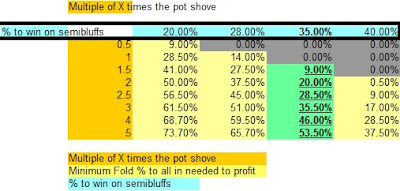 What do we learn? Obviously the closer you get to being a favorite over your opponent's calling range, the lower the probability you need for your opponents to fold. Also, you can see why I don't like to shove with bottom pair on the flop with only 20% to win. Doyle mentioned this was rare for him but it did happen from time to time. Probably most ideal would be 3 low card flop where he has some backdoor straight possibility and opponent is more likely to be playing back at him than being able to have a hand that can call to a shove very often. Playing back at the initial better on the flop with a medium strength hand isn't likely anymore so a raise means either bluff or strong hand. And it means strong hand often enough where I won't like to shove. Plus, there's usually some showdown value from trying to play a small pot with a pair and amp it up when you get two pair or trips.
However, on the rare occasion that I do decide to bet with bottom or middle pair if opponent just calls I may be likely to shove any turn card against the right kind of opponent and the right stack sizes. If a call by opponent usually means a draw or medium strength hand and I think he will fold maybe 60% of the time, I may shove if that is effectively 2 times the pot. But whether I hit or not, I will shove. A shove may only be 2 times the pot on the turn so I really do have 20% equity since on 7K2 flop opponent isn't going to behave differently if a 8 or 6 or another 2 hits the turn or if it's another card. So if I have 23, 67, 87 or a very strong hand like a set or AK, I could be shoving the turn and have either hit two pair and in rare cases I may have 56 and pick up a 4 or 8 to give me a 16% chance of hitting or 68 or 89 and pick up an open ended draw.... Possibly I pick up a flush draw as well. It will be hard for opponent to call me often enough to break me while also avoiding calling the made hands.
Determining the actual probability opponent will fold is typically done best by looking at the probability opponent will have a pair given his preflop range and given the flop.
But there are a lot of unique flops.
For example, if you have 67s and put opponent on a range of 22+,AJ+,A9s+,KQ,QJ,JT (about 14% of hands) and flop is:
89K
Opponents bet on the flop. If you shove all in what hands will call you? What percentage of hands is that?
If opponent always continuation bets we can't rule out any hand. Even if he does, as long as we can't rule out that he randomizes his bets, or don't know what it means we still cannot say we gained any information. So he could still have any of his top 14% of hands.
So what will he call with?
If he has not seen you move in a lot, he still could call with at least
88,99,KK,AA,AK,KQ
This is only 31% of his hands so he will fold 100% minus 31% or 69%.
Looking at the chart we only need 20% equity when he calls to shove 4 times the pot. We have 31.43% if we have no backdoor flush draw and 34.01% if we DO. We can shove over 5 times the pot.
If opponent calls with ALL of his hands in his range, you have nearly 40% equity on calls, but 0% chance of opponent folding. You can only shove up to 2x the pot against this opponent.
More realistically, opponent will call you with A9s and any pocket pair and AQ if he knows you're a nut AND has big cajones. That would be 70% of the opponents hands or he would only fold 30%. But you would be 40% to win so you could shove 4x the pot. However, that is WITH a backdoor flush draw. Without that backdoor draw, you are at 38% with AQ which means you can only shove somewhere around 3 times the pot. Take out ace queen and you are closer to 35% but your opponent folds 37% of the time so you can shove over 3 times the pot.
Now let's look at the same situation on an 89A flop instead.
Tight opponent will call you with 88,99,KK,AA and A9s+ and AJo+.
Although you are a good 38% to win this time, it represents a larger percentage of your opponent's 44% instead of only 31%. Opponent will fold 56% of the time instead of 69%.
Fortunately it is still enough to shove with just over 5 times the pot.
If opponent calls you with any two you have 37% equity but 0% from folds which means you can only shove only up to 2x the pot yet again.
If opponent calls with any pair he has a wider range to call with since more hands contain an ace than a king 22+,A9s+,Aj+. That makes up 74% of his range which means he will only have a folding hand 26% of the time. You are only 36% equity which is just over 35% so I would be comfortable using the chart and shoving up to 2.5 times the pot, but not much more. If I had the backdoor flush draw, I would have 40% equity so I could shove up to probably over 3.5 times the pot.
What about a raggedy flop?
A 892 flop for example with 67?
Now opponent that would call with any pair can only call with 22+ and A9s. I'm less confident that he'll do so, but he may call with AK and QJ since he'd have to be pretty loose to call with the 33,44,55,66,77 hands. So what I'll do is I'll give him 80% of the credit for calling that loose which means he'll fold 20% of the time that he has QJ and AK. That subtle adjustment bumps up his fold % from 37% to 41% but the equity stays about the same. around 37-38%. I would be comfortable shoving over 3 times the pot but less than 4. With backdoor flush draw I can shove around 5 times the pot. Big difference than when facing an ace high flop where I'm shoving only up to 2.5 times the pot, close to 3.5 with backdoor draw to flush.
If I was to add two face cards on the board with a T9 or JT type hand to draw at the straight you would find you get called even more often against most opponents preflop ranges that are also willing to call with a pair. A QKx flop for example hits AK,AQ,KQ,KJ,QJ,QQ,KK,AA and plenty of hands have draws like AJ,AT. The hands with draws, particularly if they know you shove on semibluffs, particularly when they have a flush draw as well will call you. You may also be drawing to a straight that isn't good when it hits. Since many players play broadway type hands you won't get them to fold very often at all, particularly those who do NOT also play the lower pairs and instead prefer broadway cards to 22-77.
Trying to map out all paired flops, two broadway flops, ace flop, ace wheel draw flops, ace broadway flops, all with monotone, two to a flush, 3 to a flush against a wide variety of opponent's preflop ranges and flop calling shove ranges is exhaustive work, but knowing a few situations like this better than your opponents can at a minimum give you an idea of how to adjust a particular strategy.
A little information is dangerous. I don't doubt that some people could take the supersystem and transform themselves into a winning player very rapidly in spite of a few mistakes. It only really takes one person to make a really dumb call on your large overbet shoves. As a result of them seeing you push so often you can make a LOT more money from this style. A few dumb calls opponents make when you have a monster can make the difference. Not to mention the increased chances of picking up more pots on your continuation bets.
However, If you aren't aware that overbetting too much can result in lost money, and tighter preflop opponents on flops that have a higher chance to connect with them may result in worse profits, opponents can easily adapt and beat you using the traditional semibluff shove style of the supersystem. And what about players that rarely 3bet unless they have a monster? You are shoving and they are calling 90% of the time and you are drawing slim which means you have less equity and a low fold percentage. If you are shoving even 2 times the pot you may be in deep trouble and be losing quite a bit of money with this move.
That doesn't mean this style can't be ridiculously profitable with the right adjustments to shove less often on draws and try to show down draws more while shoving more often with the twopair+ hands, and to mix it up and play some small ball for quite awhile before going back to it. However, if you aren't aware of how to adjust to break even on your semi bluffs and you don't try to adapt to your opponents you may easily get too carried away.
Overall though if you DO learn to fine tune this strategy so that semibluffs break even, you have a strong likelihood of powering table a high percentage of the time, and getting action far more often when you do have a hand and opponent has a little piece of the flop.
If for example you thought opponent would fold 80% of the time to a shove but you had nothing but a backdoor straight flush draw, you can eyeball the changes in the chart and imagine that you probably could still shove 3 times the pot and be okay. It's just a rough ballpark guess. Out of curiosity I looked it up and the actual math says 5 times the pot would be break even if he'd fold 80% of the time... If you thought 3 was the number you'd still be making profitable decisions. You may miss out on some more shoving opportunities but that isn't a terrible thing.
However, if he'll only fold 70% you can only push for about 3 times the flop. Slight differences in your estimation of how likely opponent is to call could be trouble, when you are drawing so slim against a call, but even if you keep this in mind, a conservative estimate would still allow you to capitalize off of it often enough. You may move in on a flop for 2.5x, while trying to get more in smaller pots before shoving (such as attempting a check raise rather than open shoving).
here. I also concluded with: "If I do create another post to add to the nutball supersystem it will be a table of how often opponents need to fold to 2x,3x,4x and 5x all in bets so that semibluffs break even given each individual semibluff's odds to win on the flop and then again on the turn. "
Here you go!

However, on the rare occasion that I do decide to bet with bottom or middle pair if opponent just calls I may be likely to shove any turn card against the right kind of opponent and the right stack sizes. If a call by opponent usually means a draw or medium strength hand and I think he will fold maybe 60% of the time, I may shove if that is effectively 2 times the pot. But whether I hit or not, I will shove. A shove may only be 2 times the pot on the turn so I really do have 20% equity since on 7K2 flop opponent isn't going to behave differently if a 8 or 6 or another 2 hits the turn or if it's another card. So if I have 23, 67, 87 or a very strong hand like a set or AK, I could be shoving the turn and have either hit two pair and in rare cases I may have 56 and pick up a 4 or 8 to give me a 16% chance of hitting or 68 or 89 and pick up an open ended draw.... Possibly I pick up a flush draw as well. It will be hard for opponent to call me often enough to break me while also avoiding calling the made hands.
Determining the actual probability opponent will fold is typically done best by looking at the probability opponent will have a pair given his preflop range and given the flop.
But there are a lot of unique flops.
For example, if you have 67s and put opponent on a range of 22+,AJ+,A9s+,KQ,QJ,JT (about 14% of hands) and flop is:
89K
Opponents bet on the flop. If you shove all in what hands will call you? What percentage of hands is that?
If opponent always continuation bets we can't rule out any hand. Even if he does, as long as we can't rule out that he randomizes his bets, or don't know what it means we still cannot say we gained any information. So he could still have any of his top 14% of hands.
So what will he call with?
If he has not seen you move in a lot, he still could call with at least
88,99,KK,AA,AK,KQ
This is only 31% of his hands so he will fold 100% minus 31% or 69%.
Looking at the chart we only need 20% equity when he calls to shove 4 times the pot. We have 31.43% if we have no backdoor flush draw and 34.01% if we DO. We can shove over 5 times the pot.
If opponent calls with ALL of his hands in his range, you have nearly 40% equity on calls, but 0% chance of opponent folding. You can only shove up to 2x the pot against this opponent.
More realistically, opponent will call you with A9s and any pocket pair and AQ if he knows you're a nut AND has big cajones. That would be 70% of the opponents hands or he would only fold 30%. But you would be 40% to win so you could shove 4x the pot. However, that is WITH a backdoor flush draw. Without that backdoor draw, you are at 38% with AQ which means you can only shove somewhere around 3 times the pot. Take out ace queen and you are closer to 35% but your opponent folds 37% of the time so you can shove over 3 times the pot.
Now let's look at the same situation on an 89A flop instead.
Tight opponent will call you with 88,99,KK,AA and A9s+ and AJo+.
Although you are a good 38% to win this time, it represents a larger percentage of your opponent's 44% instead of only 31%. Opponent will fold 56% of the time instead of 69%.
Fortunately it is still enough to shove with just over 5 times the pot.
If opponent calls you with any two you have 37% equity but 0% from folds which means you can only shove only up to 2x the pot yet again.
If opponent calls with any pair he has a wider range to call with since more hands contain an ace than a king 22+,A9s+,Aj+. That makes up 74% of his range which means he will only have a folding hand 26% of the time. You are only 36% equity which is just over 35% so I would be comfortable using the chart and shoving up to 2.5 times the pot, but not much more. If I had the backdoor flush draw, I would have 40% equity so I could shove up to probably over 3.5 times the pot.
What about a raggedy flop?
A 892 flop for example with 67?
Now opponent that would call with any pair can only call with 22+ and A9s. I'm less confident that he'll do so, but he may call with AK and QJ since he'd have to be pretty loose to call with the 33,44,55,66,77 hands. So what I'll do is I'll give him 80% of the credit for calling that loose which means he'll fold 20% of the time that he has QJ and AK. That subtle adjustment bumps up his fold % from 37% to 41% but the equity stays about the same. around 37-38%. I would be comfortable shoving over 3 times the pot but less than 4. With backdoor flush draw I can shove around 5 times the pot. Big difference than when facing an ace high flop where I'm shoving only up to 2.5 times the pot, close to 3.5 with backdoor draw to flush.
If I was to add two face cards on the board with a T9 or JT type hand to draw at the straight you would find you get called even more often against most opponents preflop ranges that are also willing to call with a pair. A QKx flop for example hits AK,AQ,KQ,KJ,QJ,QQ,KK,AA and plenty of hands have draws like AJ,AT. The hands with draws, particularly if they know you shove on semibluffs, particularly when they have a flush draw as well will call you. You may also be drawing to a straight that isn't good when it hits. Since many players play broadway type hands you won't get them to fold very often at all, particularly those who do NOT also play the lower pairs and instead prefer broadway cards to 22-77.
Trying to map out all paired flops, two broadway flops, ace flop, ace wheel draw flops, ace broadway flops, all with monotone, two to a flush, 3 to a flush against a wide variety of opponent's preflop ranges and flop calling shove ranges is exhaustive work, but knowing a few situations like this better than your opponents can at a minimum give you an idea of how to adjust a particular strategy.
A little information is dangerous. I don't doubt that some people could take the supersystem and transform themselves into a winning player very rapidly in spite of a few mistakes. It only really takes one person to make a really dumb call on your large overbet shoves. As a result of them seeing you push so often you can make a LOT more money from this style. A few dumb calls opponents make when you have a monster can make the difference. Not to mention the increased chances of picking up more pots on your continuation bets.
However, If you aren't aware that overbetting too much can result in lost money, and tighter preflop opponents on flops that have a higher chance to connect with them may result in worse profits, opponents can easily adapt and beat you using the traditional semibluff shove style of the supersystem. And what about players that rarely 3bet unless they have a monster? You are shoving and they are calling 90% of the time and you are drawing slim which means you have less equity and a low fold percentage. If you are shoving even 2 times the pot you may be in deep trouble and be losing quite a bit of money with this move.
That doesn't mean this style can't be ridiculously profitable with the right adjustments to shove less often on draws and try to show down draws more while shoving more often with the twopair+ hands, and to mix it up and play some small ball for quite awhile before going back to it. However, if you aren't aware of how to adjust to break even on your semi bluffs and you don't try to adapt to your opponents you may easily get too carried away.
Overall though if you DO learn to fine tune this strategy so that semibluffs break even, you have a strong likelihood of powering table a high percentage of the time, and getting action far more often when you do have a hand and opponent has a little piece of the flop.
If for example you thought opponent would fold 80% of the time to a shove but you had nothing but a backdoor straight flush draw, you can eyeball the changes in the chart and imagine that you probably could still shove 3 times the pot and be okay. It's just a rough ballpark guess. Out of curiosity I looked it up and the actual math says 5 times the pot would be break even if he'd fold 80% of the time... If you thought 3 was the number you'd still be making profitable decisions. You may miss out on some more shoving opportunities but that isn't a terrible thing.
However, if he'll only fold 70% you can only push for about 3 times the flop. Slight differences in your estimation of how likely opponent is to call could be trouble, when you are drawing so slim against a call, but even if you keep this in mind, a conservative estimate would still allow you to capitalize off of it often enough. You may move in on a flop for 2.5x, while trying to get more in smaller pots before shoving (such as attempting a check raise rather than open shoving).
Subscribe to:
Posts (Atom)