Saturday, July 25, 2015

Hand Analysis: Dead Money Grab Vs the Stop and Go

The Scenario: You are playing an online $10 buy in $1250 guaranteed tournament. With 40 big blinds after several limpers, you limped in late position with suited connectors figuring to have good enough implied odds. 3time bracelet winner Dutch Boyd on the button has made an isolation raise of around 1/4th his stack, and you no longer are getting good implied odds, but are getting 2.7 to 1 pot odds to call.

The Problem: Without knowing Dutch's exact cards or exact range, is it possible to play 87s profitably at this point?

The Set Up: Leading up to the hand dutch had been powering the table quite well and shortly after started to pick up AA, 44 and AK a few times and was on a pretty nice run of cards. So his image is more wild than usual. Normally he preaches being the bully without looking like the bully. However, sometimes you catch a run of cards and you end up looking like one more than you intended. I think that's the case here.

I believe that may turn out to be important from the perspective of chefward. Since Dutch's image is more wild than usual, chefward can more easily diagnose Dutch's hand range as wide, and determine that he won't have a hand that can call the flop quite as often as he might otherwise have assumed vs your typical player. Even though dutch hadn't made a lot of these big isolation raises, it'd be hard for chefward to give dutch credit for only premium hands here and he'd at least have to include some broadway hands and suited aces and maybe suited connectors and lower pairs in his range. That will translate into dutch finding it slightly more difficult to hit the flop enough to be able to call.

Dutch decides to from the button to isolate his standard $3300 at this level PLUS 1x per limper. The raise size actually should be 8100 if you want to be picky. Aside from a philosophical discussion on whether or not the "standard" should be normal raise plus 1x or 0.8x or 1.2x, or if he should make a multiple of the pot when he's going for the "dead money grab" I am entirely fine with this raise size and don't have any qualms about it.

I analyzed the raise over several limpers for 1.5x and 2x multiples of the pot in this "dead money grab" post. It really depends on the limpers limp range, and their ability to trap. But even with much larger raise size than the 8/9ths of what's in the middle, there's a mathematical argument for raising any two. The argument is entirely mathematical but requires assumptions about opponent's limping range that are speculative. Since the risk of 8/9ths is far less than the 1.5x and since the positional player usually has an advantage, the dead money grab with the J9o is perfectly fine.

I say no problem at all making this play as the raiser, you have to do something to keep up with the rising blinds, and waiting for aces probably isn't going to cut it.

BUT... what about chefward2 who's sitting there with a suited connector? I don't think he can play such that he can make it unprofitable for Dutch, but that doesn't mean he can't fight for his share of the dead money in the pot.

So say you're sitting with 87s after several limps and a seemingly LAG player raising behind you. You're getting 17,000 to 6400 or 2.656 to 1. Certainly if you knew the hands were always checked to the river you'd only need to be 27% to win. But it will almost never check to the river. Especially out of position with shallow stacks, you can't make the usual assumptions. You can't assume postflop that "bets break" postflop so you cannot just assume if you are 27% equity it's a good call. Instead you will be committed on the flop to either calling or folding.

While you may get some implied odds, You most certainly are NOT getting the implied odds to hit 2 pair or a straight or flush. You do have some fold equity on a jam, but probably not enough to jam any flop here. Even if you include 8+outs in addition to any two pair or better hand you are only going to be hitting around 25% of the time. With that range of hands, depending on Dutch's range, you'd probably need to be getting much closer to 3 to one pot odds because you'd probably only be slightly ahead of Dutch's calling range.

So the next question is can chefward just shove every single flop profitably? I say the answers also no.

You're not getting 1:1 on your steal attempts because you're just calling preflop. You're actually risking over 30k to only get the 17k that's in the flop before your decision. You gotta be right close to 66% of the time to break even on your pure bluffs or make enough from your shoves when you do hit to make up for the difference. Probably not happening if you always shove.

We certainly could try to come up with a more precise answer to this in terms of what sort of range our Dutch has to have and has to raise with and call a flop shove with to make a shove with any two profitable, but it probably will involve folding some pairs and when you are getting 2 to 1 it's hard to fold a pair since you will only flop a pair 1/3rd of the time and you probably will have some outs... I just think Chefward's opponent (in this case Dutch) will have a pocket pair or flop a pair or combo draw too often for an autoshove to be correct. And if that's the case, where does that leave you? Does that mean you should fold?

Not so fast.

In order for a call preflop to be profitable for chefward, he has to be creative. The stop and go play with any flop is too reckless and the fit or fold style is too tight. So we have to determine if there is somewhere between where it may work.

How much equity is it going to cost chefward to also push with any pair on no facecard boards and pair with backdoor draws such as 3 to a straight with 87 on a 76J or 89A flop for example? Well, on a board like 56J with a single spade he's still going to be 27.37% to win vs KK. That's not bad at all. Sure he's only 8.25% vs a set but that's a small percentage of his Dutch's range.

While I think it's probably more ideal to take an exploitative solution of checking our made hands far more often, and open shoving our semibluffs and pair with backdoor draws, it's far easier to look at this as more of an all in or fold calculation, and it's already pretty complicated with shove or fold, without adding in a mixture of checks folds and check shoves and shoves.

Chefward may even be able to shove with only a backdoor draw. Sometimes he's going to be against AK, get called, and actually be ahead. If he shoves with a 5 and a spade or a 9 and a spade and no pair he is 10.40% to win against say KK and 7.37% to win vs a set, but he is about 30.6% vs two overcards. Certainly that's not terribly ideal, but when you have a lot of fold equity and also are planning on shoving with straights, flushes, two pair, trips, and 8+ out draws the collection of all your shoves gives you pretty good equity when called.

So let's just look at the equity vs a few basic flops, estimate the probability of a similar flop, and try to estimate the overall equity of the decision to shove certain flops. Then we can look at the dutch's approximate raising range and approximate the probability he is going to find a call there.

So let's start with the pure double backdoor draws.
On a 6s Kh2d flop I don't know that we'll get called as often as we should because of that King, but just so I try to approximate the averages of the same flop with a T,J or Q flop I'm going to include AJ+, 99+, 22,66 plus KT+. When I do this, we have about 15% equity. Certainly could be a lot worse, especially since on these types of flop Dutch will probably have a decent chance of folding. I have a feeling shoving with ALL backdoor draws is too much and will tend to make the AVERAGE equity when called too low, but I think including some of these shoves may end up being right just because we aren't going to flop made hands and strong draws often enough not to include some bluff shoves, nor can we shove on the AK2 type of flops where we have nothing at all and no backdoor draws.

What about a 92J flop. This represents backdoor flush draw with the "idiot end" of the gutshot. If we have 78s and are facing a calling range of 22, 88+, A9, T8,T9,QT, any Jack in his range, some ace kings and some Ace queens (because that's a hand that he may fold, he may not so by only including some we weight for the possibility that he doesn't) Then I come up with about 22.9% equity with 78s. Certainly that's not the best flop, but once we add the fold equity in on a flop like that, it may be okay to shove as part of our entire shoving range since our overall range will be much stronger than the lowest 25% of our shoving range.

If we change the flop to 98K with backdoor flush draw AND now we have a pair and backdoor straight draw, now the equity is up to about 37% given the hand range I come up with. Pretty good.

Now if we add in open ended straight draw with backdoor flush draw we shoot up from the 15% equity we had with only double backdoor draws to 38% equity.

If we have a flushdraw and a backdoor straight draw our equity is nearly 40%. Actually, I forgot to add flush draws in Dutch's range.

If we crush the flop with 2 pair, we are probably far better than 75% up to around 80% or as bad as around 70% depending on how much credit Dutch gives us and depending on whether or not there are flush draws for Dutch or backdoor flush draws for us.

If we flop a straight we are probably above 85% vs Dutch's calling range.
If we flop a flush we are probably about 85% as well since many hands that hit the flop will also have a redraw to either a fullhouse or higher flush.

The difficulty in the math is now subtracting the overlaps. For example, there may be a 16% chance of hitting a gutshot draw on the flop, but that includes when you hit gusthot as part of a combo draw including gutshots, double gutshots, gutshot with flushdraw and/or overcards and when you do the math of backdoor flush draw it is going to include backdoor flush draws plus gutshots or open ender or whatever.

You are not looking at the probability of a double backdoor draw, but the odds that a double backdoor draw isn't also a gutshot or a straight draw, or otherwise you end up counting them twice. I'm not going to do all of the math here, instead I'm going to do a really rough approximation. If anyone knows any tricks or software that can help, I'd like to hear it. I think flopzilla may be the tool I need if I want to be really accurate in this stuff but there are others too, I'm sure.

Based upon my calculations, assuming the equity stays as calculated if Dutch's calling range represents 60% of his holdings, it's not profitable to include double backdoor draws and gutshot draws and if we do, overall the strategy is unprofitable by over 300 chips. If Dutch calls 50% of the time, it's not profitable to shove with double backdoor draws, but it is profitable to shove with gutshots and overall the strategy is profitable. If Dutch calls 40% of the time, it's profitable to shove with double backdoor draws, but probably the worst of flops are unprofitable to shove.

Overall, I think if Dutch's range preflop is wide enough chefward could probably make the call profitable if he was very calculated about which flops he shoved. I also think that if many of the calling hands would be a very difficult call to make, we can justify the call.

Since we are calling 6400, the pot will be 23400 on the flop. The effective stack signified by the shorter stack (in this case Dutch) is 24387 behind. So if you are to shove the flop, you are putting in BOTH the 6400 to call PLUS 24387 or a total of 30787 to add 17000 to your stack from this stage in the decision tree. If you shove and are drawing DEAD when called, you have to get folds nearly 2/3rds of the time. But as we know from the analysis we just did, you are rarely drawing dead, and probably can avoid shoving the worst of the flops.

In Conclusion, chefward almost certainly cannot make 8000 worth of profits which is what's needed to make Dutch's decision unprofitable on his own, but it seems he can probably make a selective stop and go profitable to fight for a small share of the dead money AT the cost of great volatility to his own chipstack, that given ICM factors may not be worth the chips he gains. After working the math I can conclude that my intuition that calling CAN be marginally profitable for chefward2 is correct, but the margins are very thin and seem more thin than I would have thought, and given ICM impact that chips you gain are worth less than the chips you lose, it may be better for chefward to fold anyways. It's one of those really razor thin decisions where either one could be correct. Certainly it's not terrible to gamble a little bit to potentially knock out a talented player, particularly if there's enough dead money that it's positive chip EV and go down swinging at who you perceive to be the biggest threat at the table to you taking the title.

But you can also argue that there's no reason to fight so hard in a go big or go home situation when you have almost 40 big blinds and there are better spots.

With that being said, I'm pretty confident it's possible to get more precise about which flops you can shove with given a lot of in depth analysis of ranges. I very much doubt that chefward has done the kind of work to get there... but who knows, maybe he has. Some flops will be hard enough for your opponent to call, or will miss opponent that even if he does that it will be profitable to bluff shove a lot more, where other spots you will have a decent draw and still  have to fold because opponent's range crushes yours. Like if you had T9 and flop was KQJ, a Ten brings you a straight but probably is almost never good when you get called and hit.

I also still think that you could milk a little bit more out of calling preflop if you check the flops you hit hard enough to be a favorite vs calling range(12+ outs or 2pair+), you will get paid off more, and the result is that you probably will not have to semibluff shove quite as light because of the added equity you get most of the time from checking. You also may be able to get your money in with one pair hands this way and end up ahead if the flop is exactly right (like all 3 flop cards below ten or 3 uncoordinated cards and only one of them being a non ace face card).

I think Dutch probably can find a call 55% of the time chefward shoves. If he starts unpaired, he'll pair up 1/3rd of the time, plus he'll start with a premium pocket pair often enough and hit a big draw himself often enough or have overcards like AK and a chance at having the best hand often enough given the pot odds to make a call. I think it might be closer to 50% in Dutch's case and closer to 60% in the typical opponent's case who doesn't punish the limpers as liberally as they should, but I think 55% is a fair, conservative assumption that chefward should be comfortable making.

Even though it's unprofitable to shove double backdoor draws... if we don't have these in our range we lose too much from check/folding too often such that it is more unprofitable if we don't include them than if we do. So we have to include all gutshots too. The ideal solution to make the most profit is going to only include some of the double backdoor draws, and probably include some more one pair hands without double backdoor draws when the flop misses opponent's range, but I am not going to try to even come close to solving this since I already took some liberties in approximating my assumptions and it would be a nightmare to try to solve every scenario.

So I think if you were VERY VERY precise you could make a selective stop and go play in this spot profitable to the point where it might even be worth it after factoring in ICM, but that would require virtually a photographic memory and a lot of hours of work that are best suited working on core concepts that can help develop better "feel" instead of memorizing precise decisions for exact situations that will almost never arise again.

Nevertheless, it's a very interesting topic for consideration. It would be interesting to look at the stop and go with suited connectors in the same spot when we have a lot more chips behind and thus have better implied odds to hit the better flops. It also would be interesting to compare it where you are even shorter stacked such that you can jam any pair and you get more out of your semibluffs due to not laying as big of a price vs hands that can call you. If we could get a few spots like that, we could develop a much better "feel" for making moves like this profitably and then repeat that with a ragged ace or two offsuited broadway cards or low and medium pairs so that overall we have a good "feel" for when to make a more flop texture based stop and go with around 10 big blinds, 15 big blinds, 20, 25 and the check raise shove variety of the blind defend vs someone who always Cbets as well as vs a more selective Cbetter that Cbets 60% of the time.  If you never limp, you don't probably need to concern yourself too much with the stop and go to defend against a potential dead money grab, but there may still be some spots to use it from the small or big blind.

Tuesday, July 21, 2015

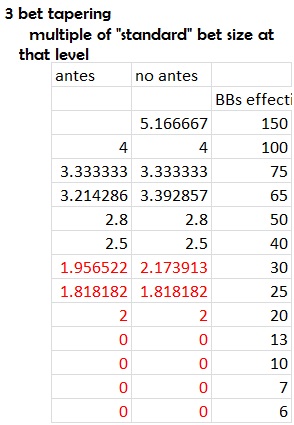
Tapering

Tapering is a concept that means over time you lower the size of your bets. It was given this label by Dutch Boyd in a pokerclinic and on his twitch stream. The concept was not invented by him but he deserves credit for going into details. He inspired me to go deeper into this concept.

The reason this is effective is because as the blinds get higher, the % of risk you are taking declines. In order to do well in tournaments, you want to extract a skill edge and accumulate chips without risking your tournament life if possible. Also, opponents become more willing to fold rather than defend their blind because even if they are getting the pot odds to call, they don't have as good as implied odds, and it simply risks a lot of chip volatility for just a small edge that it may be better to give it up.

Whether or not that is true shouldn't effect the decision to raise; As long as our opponents believe it's correct to fold or feel they should fold, raising smaller becomes more correct preflop

Of course spots will come up that you will learn to accept because otherwise you will be more likely to become short stacked and forced to move all in anyways, so at some point it's worth doubling up to prolong your desperation later and finish deeper.

With a smaller raise size you are getting better odds on steal attempts and can open with more hands and defend more often if you have the stack to.

I'm always looking for new wrinkles in my game so what I actually want to do is consider tapering POSTFLOP as well.

Ed Miller on continuation bets gave me food for thought about not Cbetting and checking behind based more on flop and entire hand range strength vs that flop, and less about your specific hand so he deserves credit for some of the nuances about what situations are less necessary to Cbet.

So I'm experimenting with introducing an entire tournament plan.

1)Start out with 4.5x preflop. Since you are risking 4.5 to get 1.5, you need to have a better hand or optimal opponents can exploit you. Assume opponents defend to force bluffs to break even, plus some bluffs, plus some of those defending hands are calls. So opponents collectively should have a 75% chance that their hand is best. Determine what hands have value over this range and multiply that hand range by 4 and this is your opening range.
2)Since opponents are not optimal early they will probably call more often which means you want to extract more value postflop but also that you will have to be more picky. Rather than be too picky about what hands you Cbet with, look more about position and flop texture with some slight adjustments to not bet a few middle strength hands and draws with showdown value that may get action from worse hands only after checking and to give up on the worst of hands with no pair, no draw, no backdoor draw.
3)IN position: bet all flops except check most paired flops, check all Ace high flops and King high flops check all but the wettest Queen high flops and check only the driest of Jack high flops. Only check dry ten high flops when you have two overcards as well as sets, twopair and some overpair and some backdoor draws.
Out of position: Out of position you actually want to bet the flops above that you check plus all jack and ten high flops and the wettest 9 high flops.
4)Bet sizing - Since out of position you will be firing two bullets more often when you bet, you want to bet smaller amounts, but it still needs to be large enough. Over half the pot is fine early on. In position you will be betting pot sized bets.

Later on this will invert. Early on you are going against weaker players so you probably want to build up a big pot since you are starting with a better hand. Later on you won't have deep enough stacks to fire multiple bullets out of position and you will be betting more often in position and it won't require as much to take it down and you will be tending to bet with more hands and want a better price on bluffs.


1) 4.5 BB opening hand range (adjusted for implied odds) no antes
8    99+,AK+,ATs+KQs+,QJs,JTs,T9s,98s,87s,76s,65s
7    88+,AK+,A9s+KJs+,QJs+,JTs,T9s,98s,87s,76s,65s,54s
6    66+,AQ+,A9s+KJs+,QJs+,JTs,T9s,98s,87s,76s,65s,54s
5    44+,AQ+,A9s+,KTs+,QJs+,JTs,T9s,98s,87s,76s,65s,54s
4    22+,AJ+,A8s+,K9s+,Q9s+,J9s,T9s,98s,87s,76s,65s,54s
3    22+,AJ+,A2s+,KQ+,K8s+,Q8s+,J8s+,T7s+,97s,87s,76s,65s,54s
2    22+,AT+,A2s+,KQ,QJ,JT,T9,98,87,76,65,K9s+,Q8s+,J8s+,T8s+,97s+,86s+,76s,65s,54s
1 22+,A2+,K5+,Q8+,J8+,T7+,96+,86+,75+,64+,54,A2s+,K2s+,Q2s,J7s,T6s+,95s+,85s+,74s+,63s+,53s+,43s

3bet 4x raiser (not properly adjusted to mix in calls and bluffs)
8) 3.53% TT+,AK
7) 4.03% 99+,AK
6) 4.68% 99+,AQ+
5) 5.59% 99+,AQ+,AJs+,KQs
4) 6.94% 99+,AQ+, ATs+,KTs+,QJs
3) 9.14% 77+,AJ+ATs+,KTs+,QTs+,JTs
2) 13.40% 44+,AJ+,KQ,A8s+,K9s+,Q9s+,J9s+,T9s
1) 25% 22+,A8+,KT+,QT+,JT+,A2s+,K7s+,Q9s+,J9s+,T8s+,98s,87s,76s


3xBB no antes opening range (adjusted for implied odds) no antes
8: JJ+,AK || 77-TT A9s+,KTs+,QTs+,[67s-KQs]
7: JJ+,AK,Aqs || 55-TT, A9s+,KTs+,QTs+,[67s-KQs]
6: JJ+,AQ+ || 33-TT, A4s+,KTs+,QTs+,[45s-KQs]
5: TT+,AQ+ || 22+,A4s+,K9s+,Q9s, [45s-KQs]
4: 99+,AQ+,AJs,KQs || 22-88, A2s+,K9s+,Q9s+, [64s-J9s]+,45s
3: 88+,AJ+,ATs,KQs || 22-77, KQ, A2s+,K9s+,Q9s+, [64s-J9s]+,45s
2: 66+,AT+,KQ,A9s,KJs+ || 22-77, [78-QJ], A2s+,K2s+,Q8s+, [53s-J9s]+
1: 44+,A7+,KT+,QJ,A2s+,K9s+,QTs+ || 22,33,A2-A6,k2-K9,Q8-QT,J7+,T7+,97+,[45o-87o], Q2s+,J7s+,T6s+,95s+,85s+,74s+,64s+,54s,43s

3bet 3x raiser (not properly adjusted to mix in calls and bluffs)
8 8.3% 88+, AJ+,ATs+,KTs+,QJs
7 9.43% 88+, AJ+, KQ, A9s+,KTs+,QJs,JTs
6 10.91% 66+, AJ+, KQ, A9s+,KTs+,QTs+,JTs,T9s
5 12.95% 66+, AJ+, KQ, A9s+,K9s+,Q9s+,J9s+,T8s+,98s,87s,76s,65s,54s
4 15.91% 66+, AJ+, KQ,QJ,JT, A8s+,KTs+,QTs+,J9s+,T8s+,97s+,87s,76s,65s,54s
3 20.63% 55+, AT+,KT+,QT+,JT,A7s+,KTs+,Q9s+,J9s+,T8s+,97s+,87s,76s,65s,54s
2 29.29% 22+, A9+,KT+,QT+,JT,T9,98,87,76,65,A2s+,K9s+,Q9s+,J9s+,T8s+,97s+,87s,76s,65s,54s
1 50% 22+,A2+,K4+, Q8+, J9+,T8+,98,A2s+,K2s+,Q2s+,J5s+,T6s+,96s+,85s+,75s,64s+,54s

Giving you a good idea of how to balance your ranges with help from Ed Miller in the book "the course" I came up with a few tweaks and the following ranges.

When facing tight raise
If you have QQ: if left card is black, 3bet, if left card is red, flat.
Otherwise:
3bet: AA,KK,[QQ],A5s,{T8s}
flat: 22-JJ,[QQ],AK,Ats+,Kts+,Qts+,{JTs,T9s,98s,87s,76s}
{only flat the suited connectors in position and only raise T8s in position}
When facing loose raise
3bet: QQ+,AK,A2s-A5s,{T9s,87s}
flat: 22-JJ,AQ,A6s+,KTs+,QTs+,JTs,{98s,76s}
{in position only, otherwise fold}

4bets:
When Facing a 3bet:
4bet:QQ+,AK+,AQs, A5s,T8s
flat:88-TT,[QQ],AQ,AJs,{AJo,ATs,KQs}

2.25xBB
Antes:
8: TT+,AQ+,Ajs | 22-88, A9s+,[45s-KQs]
7: TT+,AJ+,Ats+,KQs | 22-88, {A9s-J9s}+,[45s-KQs]
6: 88+,AJ+,Ats+,KQs | 22-88, A4s+,{A9s-J9s}+,[45s-KQs]
5: 77+,AT+,KQ,A7s+,KTs+ | 22+,[KQo-T9o],A2s+,K9s+,Q9s+,[64s-J9s]+,54s
4: 77+,A8+,KT+,A2s+,K9s+,QTs |22+,[45o-KQo],K7s+,Q8s+,J8s+,[53s-J9s]+,43s
3: 66+,A8+,KT+,A2s+,K9s+,QTs+ |22+,[45o-KQo],K4s+,Q8s+,J8s+,[53s-J9s]+,43s
2: 22+,A2+,k2+,Q2+,J5+,T7+,97+,86+,Q2s+,J2s+,T2s+,94s+,84s+,74s+,64s+,54s,43s
1: A2+,K2+,Q2+,J2+,T5+,96+,85+,75+,64+,54,T2s+,93s+,84s+,74s+,63s+,53s+,43s


3bet (not properly adjusted to mix in calls and bluffs)
8 8.3% 88+, AJ+,ATs+,KTs+,QJs
7 9.43% 88+, AJ+, KQ, A9s+,KTs+,QJs,JTs
6 10.91% 66+, AJ+, KQ, A9s+,KTs+,QTs+,JTs,T9s
5 12.95% 66+, AJ+, KQ, A9s+,K9s+,Q9s+,J9s+,T8s+,98s,87s,76s,65s,54s
4 15.91% 66+, AJ+, KQ,QJ,JT, A8s+,KTs+,QTs+,J9s+,T8s+,97s+,87s,76s,65s,54s
3 20.63% 55+, AT+,KT+,QT+,JT,A7s+,KTs+,Q9s+,J9s+,T8s+,97s+,87s,76s,65s,54s
2 29.29% 22+, A9+,KT+,QT+,JT,T9,98,87,76,65,A2s+,K9s+,Q9s+,J9s+,T8s+,97s+,87s,76s,65s,54s
1 50% 22+,A2+,K4+, Q8+, J9+,T8+,98,A2s+,K2s+,Q2s+,J5s+,T6s+,96s+,85s+,75s,64s+,54s

3bet or flat:
when facing tight raise
3bet: QQ+,AK,A2s-A5s,T9s,87s
flat: 22-JJ,AQ,A6s+,K9s+,Q9s+,J9s+,T8s+,98s,76s,65s,54s
when facing loose raise
3bet: TT+,AQ,AJs,A2s-A5s,T9s,98s,87s,76s,65s,54s
flat: 22-TT,AJ,KT+,QT+,JT,T9,98,87,76,65,54,A6s+,K9s+,Q9s+,J8s+,T8s,97s,86+,75s

When Facing a 3bet you might construct some balance like this as the "default" range with no information.
4bet:QQ-KK,[AA] AK+,AQs, A5s,T8s
flat:88-TT,[AA] AJ-AQ,ATs,KQs.
(or looser, but obviously this is more opponent dependent)

2x only needs to succeed 47% of the time. So opponents should raise to force you to break even so they need to raise 53% of the time collectively.
8 9%
7 10.2%
6 11.8%
5 14%
4 17.2%
3 22.23%
2 31.4%
1 53%

The shortcut is to increase this range by 50% since half the hands have value and then you want to open raise 3 times as often as you can bet for value.
8    13.50%
7    15.30%
6    17.70%
5    21.00%
4    25.80%
3    33.35%
2    47.10%
1    79.50%


When you get under 40BBs but especially under 30BBs, you do lose some utility in dealing with 3bets preflop and your "tapered" Cbets becomes less than half the pot which at some point may cause it to lose some effectiveness even though it doesn't need to succeed as often when it is smaller. The main reason being that opponents are more likely to see a showdown because they will widen their range some, even if they don't widen it "enough". Once they start seeing the hands that you show down you are much more likely to see opponents widen their range even more. Alternatively you must create suboptimal shoving stacks on the river, or potentially shove earlier than the river, or check more often. None of these options is ideal, but it's just the nature of most blind structures.

Your opponents can now open shove so you have to have a hand often enough to call off. If not, you are exploitable. This means that in order to prevent being exploitable you'd be forced to tighten your opening range up slightly or call off in situations even when the bubble factors likely will suggest otherwise, or just be exploitable until opponents prove that they are capable of exploiting. Neither option is particularly appealing, so while limping in also isn't particularly "optimal" either, you at least can do so in a defensible way, and use the advantage of being the last one in. Either you can "exploit the exploiters" who try to "punish the limpers" as well as those trapped behind by limp raise shoving more frequently,or at least frequently enough as part of your range to not be exploitable, or you can limp in with drawing hands and good multiway hands vs loose/weak-passive opponents. This allows you to use blocking bets to control the size of the bet in multiway action to both play more hands than you normally would and also reduce the volatility of your chip stack in exchange for possibly giving up some value in your ability to bluff and steal through bets and Cbets.

I can't say whether it's better to give up the value of raising in exchange for the utility of not allowing opponent a more optimal shoving opportunity. I can't say if gaining back the utility of a larger Cbet closer to half the pot or over half the pot is worth the lost value in limping. I can't say if the ability to limp-raise shove a more optimal stack or add more multiway playable hands and gain the implied odds is worth what you give up by limping.

I won't even argue against utility theory that getting your money in worse than ICM suggests order to make up for it due to additional utility gained due to a larger stack, more fear/fold equity, and the utility to play more streets at more optimal bet sizes. Any decision on "which is better" is speculative until I see someone prove otherwise. But you need to speculate based upon your own awareness of the opponents and your personal skillsets and observations as well as the stage in the tournament.

You should be aware of this and recognize that this stage is coming and be prepared to deal with it in whatever way works best for you given the stage in the tournament. Some might limp to preserve consistent betting throughout. Others might check more, others may give up after the Cbet and double barrel less. Others might get it all in on the turn more often for value, and some may even open shove far more liberally earlier than they're "supposed to", hoping to gain back what they're giving up in EV in the future due to larger bubble factors of opponents who face them and utility of Cbets and more streets in 3bet pots and such often enough to make up for it.

Just because you can play all streets for value, doesn't mean you need to bet every street. Particularly with marginal hands and shorter stacks preserving your tournament life and ability to accumulate chips at low variance is more important than maximizing value. Early in tournaments against looser players you are trying to get called and maximize value. Later on you are trying to get folds and maximize bluffing equity.

You also probably want to taper your 3bet sizes as well, But when there is a 3bet and you see a flop without a 4bet you probably will be getting your money in after 2 streets of betting instead of 3 so you can set up a shove to be around the pot by strategic 3bet sizes.


If you get too much below 30BBs a 3bet probably is all in (depending on the raiser's initial raise size and if the antes are involved), or at least is made with intention of calling an all in and probably getting it all in on the flop. At exactly 30BB, if your 3bet is less than 7.5BBs total you aren't necessarily committed if you have a small percentage of hands in the 3bet/fold to 4bet range.

I don't really see much value in minraising except to get opponent committed to calling all in but I'd rather just shove and try to take down the equity even if I had a real hand. Alternatively you could 3bet normal, be willing to call any all in and if opponent calls just have a shove or fold range with a high probability of shoving the flop.  Probably just calling or shoving is best below 30 BBs though and keep in mind calling is putting in more than 10% of your stack so you don't have very good implied odds. You shouldn't call unless you're ahead, and if you're ahead you're probably better shoving.

For this reason I don't know that raising preflop under 30BBs has all that much value unless opponents are folding too often and not shoving often enough and also calling sometimes when they should shove. But again, whether you bet, call, or shove or taper, any decision when you are under 30BBs gives up something. Getting above 30 may not gain it back either if most opponents are short stacked. It is probably just the nature of tournaments

Tapering The Flop
When you taper your bets on the flop you have to understand that larger bets are offering a worse price on your bluff attempts. Early on you are generally betting larger to isolate the fish. Even though your opponents are offered a worse price and should call less, the tendency for opponents to not properly adjust to bet size means that you should be more selective about how frequently you bet. You also don't need to bet as much to make as much. With the possibility of raises it won't take much to get full value out of your good hands anyways.

In position: Most flops that you are recommended to check, you can also call when faced with a bet rather than raise when you have a strong enough hand to continue when faced with a bet.

4.5xBB stage - Check Q high flops, King high flops and A high flops and paired flops. Check some dry Jack high flops. With few exception you will ALWAYS check these flops. You also will mix in some checks on dry Ten high flops provided you either have 2 overcards or a backdoor draw or flop an unbeatable nut hand like top set with no possible draws or a straight with outs to a flush redraw to beat a split. Half the time you will check overpairs, half the time you will bet. (left card red, bet, left card black, check) You will bet pure bluffs, medium strength hands.

3.5xBB stage - check ace high and king high flops and paired flops. Check only the dry Queen high flops. Treat some Jack high flops mostly like you treated Ten high flops in the 4.5x stage. Also check most of the worst hands in your range given the flop. For example, if you play any suited connectors, any pocket pair and AJ+,KQ,QJ on a QJ9 flop most suited connectors are probably bad enough to check and give up on. You can check the worst of your medium strengthed hands for stack preservation. If you have J8s or QT or T9 on JT4 board normally you'd bet, but you are almost never going to get a worse hand to fold, and a better hand will certainly call. This is a clear spot to check as NOW opponent on the turn may begin to think his T8 or 45 is good, and he may make the mistake of calling 98 after bricking thinking his 9s and 8s are live, plus he may plan on bluffing certain river cards because he thinks you are weaker. He may now call with ace high,22-99, A4, and any card he may pair on the turn. He may also try to bluff hands that he was willing to give up on. There's no value in betting those hands other than taking the equity that is in the pot. Remember, in this stage usually a check means weakness so a smart opponent will give you value after a check.

3xBB - Check all ace high flops, and some King high flops and paired flops with a single face card or paired face cards. In terms of hands in your range you check, occasionally check draws and medium strength hands only. You can semibluff if opponent shows weakness two streets in a row and still build up a big enough pot for the river if you hit either the turn or the river. Your weakest hands due to the decreased size can now be bluffed rather than given up on, and many times you will bet your longshot (4out draws) and monster (12+out draws).

2.25 or 2.5x stage - check ace high flops sometimes, check paired flops with one or two Ace or Kings in them. Occasionally check full house or better and usually check top pair, medium or weak kicker on dry board type of hands. You aren't necessarily doing this to reduce to 2 streets of value, but instead to get 2 streets of value more often and preserve your tournament life in the instance that you are up against top pair better kicker or better, while also getting 1 street of value more often as well by inducing bluffs and weak calls.

2xBB stage - Check paired flops with at least one ace or king in them, check dry ace flops with an additional face card. Rarely pass up an opportunity to bet since you are betting small and are getting a much better price on your bluffs. Since you have a wider range of hands preflop you must not slow play your hands or even your draws or you will be too predictable.

Short Stack Limp In or desperate stages where all ins will occur before the river - Shove 4out draws, any pair except for pocket pair lower than the 2nd highest flop card without at least a straight draw as well. Check double backdoor draws and strength and 6+out draws. Usually shove 8+ outs on turn if a shove on the turn card tells a believable story, and there are not river bluff cards to represent (such as more obvious draws or double flush draw boards when you picked up the back door flush draw). Also shove strength on turn and made draws. Always shove 14 outs on turn.

Checking draw heavy boards - When you are in position usually you shouldn't check draw heavy boards but if you are facing a good, tricky opponent or an unknown you may want to check the flop anyways when your hand has some showdown value to avoid complicating things

Tapering Out Of Position On The Flop:
Strong flops out of position are the opposite of strong hands in position. If a lot can change with a single card, it favors being in position typically. It's hard for position players to know where they're at and they have no idea what cards are scary for you. Firing two barrels or floating the flop out of position then checking and if they check betting the river makes it pretty easy to play since there's very few cards that opponent can probably hit after you call the flop that can make opponent feel confident about his hand if he doesn't have an ace.

4.5BB stage - Cbet paired flops and A high and King high flops only. Also some dry Q high flops when you have AK or paired your queens. Otherwise only bet or check raise your good hands.
3.5xBB stage - CBet paired flops, A high, King high, Queen high flops and two overcards on dry Jack high flops
3xBB stage - CBet paired flops, flops where J to A is the high card. Cbet T high flops when you have any piece of it or two overcards of any kind or middle pair. Also bet big draws and big hands and the worst of hands that have no shot at winning otherwise.
2.25-2.5x stage - CBet T high flops or higher. Cbet some dry 9 high flops.
2x stage - Cbet all flops where the lowest card is 7 or higher.
Multiway - Generally don't Cbet multiway but later on it's fine if you get 2 callers or less or 3 callers and are in position.

Saturday, July 18, 2015

Crushing Tournaments Part 2: Bubble Factors

In the last post we did our best to establish a few spots for the actual bubble factors in most tournament bubbles. To get a good graphical representation of how the bubble factors change over time with a few different payout structures, read the poker book "Kill Everyone" by Lee Nelson, Tyson Streib, and Steven Heston.

At this point, we want to look at how the chip utility theorist should potentially play with a bubble factor of 0.8, and how the theorist that opportunity cost is more valuable than the ICM suggests should play by looking at a bubble factor of 2 on the bubble.

We also will eventually look at how we should play with 1.2 bubble factor so between all of these factors you can get a good "feel" for where a bubble factor of everything between would be as well as try to project what bubble factors of 0.6 and 2.5 would look like so you have a better "feel" for correct play than your opponent.

Another thing that I would like to do if I find the time is look at based upon how opponents are "supposed" to play to a 3bet, just how wide of a range can we 3bet shove profitably. Then we can examine what happens to our 3bet shove range if we look at the overall chips we gain as worth 1.6 times less than the chips we lose or 1.2 or 1 or 0.8?

A player need not memorize every single scenario. If he is good at estimation, ball park figures and has an imagination, just a general concept of how to adjust is fine. A player can probably develop a far better "feel" for the game by working several mathematical scenarios and looking at a few general concepts and tables and playing a few hundred hours than someone who plays thousands of hours and can still easily be fooled by randomness, particularly in a tournament where conditions change constantly.

Pot odds and win odds to call an all in chart:
You need 1.2 better pot odds with a 1.2 bubble factor if you are 50% to win. Normally if you are getting 2 to 1 you need to win 1/3. If you are getting 4:1 you need to win 1/5. However, if you include bubble factors you may need a greater probability of winning because you cannot accumulate 100% of the prize pool in a tournament. This chart is to train you to understand how to adjust as a utility theorist you should adjust.
Pot odds divided by bubble factor is tournament odds.


You can also look at specific situations

yellow=open push, green=you are 3bet shoved on for this many BBs, blue=someone else raises and is shoved on for this many BBs

The ICM bubble factors near most SNG bubbles is around 2.0. In supersattelites it can skyrocket from 3 with 30 players left if it pays 20 and shoot to 12 and then 20 at the stone cold bubble, since you only are playing "not to lose" to get a seat. In MTTs it usually doesn't rise much past 1.6 unless it's one of those top heavy payouts where the final table bubble AND the money bubble are the same time. In those instances is may rise to around 2 by the stone cold bubble. In the main event the money bubble is only around 1.4 but as it approaches the final table bubble the bubble actually has a higher bubble factor than the money bubble and rises beyond 1.4 in day 5 and by the end of day 7 it rises close to 1.8. If you are the shortest stack left, you no longer can wait for people to bust each other so your bubble factor is less than some of your opponents. In fact, in reality there should be an interest the larger stacks should have in keeping the smaller stacks alive so that they can steal from each other. You'll be able to get a much better feel for bubble factors if you either use an ICM simulator or trainer or two or check out the charts on the poker book titled "Kill Everyone".

As with any "chart", practice implementing one thing at a time consciously until you get a good feel for it and then move onto the next part of your game you want to develop a good "feel" for it. You want to not have to think about so many different factors and have a really good feel for the odds in certain spots, the ranges of opponents, the odds you need to justify the decision so that you can objectively determine how strong your hand needs to be BEFORE an event happens that you are put in a tough spot. Instead, anticipate several actions before a hand gets dealt and try to assess your minimum threshold for any spot.

0.80 bubble factor.
There are only 2 ways I know of that a bubble factor could be less than 1. Either there is a huge overlay due to guaranteed prize pool that doesn't attract the expected number of buy ins in a winner take all spot WITH bounties, or if you are a "Utility Theorist" under the right conditions.
If you believe in Utility Theory you are betting that you have a much greater edge with more chips than without and can parlay a double up into a much higher probability of winning than the ICM suggests. That is much more true when facing the one of toughest, aggressive opponents seated to your left that prevent you from stealing your way to victory at a weak table and you have a chance to knock that player out, particularly in a faster blind structure where if you don't take action now you won't get a better shot.

The strength of utility theory depends upon how much better you are with a deep stack and how fearful opponents are of their tournament life.

As utility theorist, you should usually have a slightly lower bubble factor than ICM suggests. As such, early in a tournament when ICM suggests 1.0-1.2 bubble factor you may adjust it to as low as 0.80. But as it rises to 1.6 you might adjust it to 1.2 or 1.4 so you are still gunning for the win, without trying to accumulate 100% of the chips as if it's worth 100% of the prize pool. I could never endorse a strategy much more aggressively than 0.80 bubble factor, even if you are a much better deep stack player and it is a very long tournament.

ICM and bubble factors prove players SHOULD respect stacks that can knock them out and that actually creates a greater expectancy for those with more chips that should result in a greater advantage while the ICM assumes equally skilled players. Also, skilled deep stack players should have a greater BB/100 win rate than skilled short stack players for the most part because their all in value bets earn more. Having a chiplead has an inherent advantage that should result in future edges that can more than make up for the equity you gave up by calling or pushing too liberally earlier, but it also needs to make up for the future opportunity you give up to potentially see more profitable spots and survive.

Your survival and ability to survive to more lucrative stages of the tournament such as surviving the antes a larger percentage of the time can easily result in more chips and eventually getting the chip lead anyways so the "utility" advantage probably isn't quite as great as some might otherwise think.

Nevertheless, I don't mind mapping out a strategy to see what a utility theorist strategy would look like and there are conditions where I believe it may apply. Also, I can't disprove that Utility Theory might not allow for greater profitability overall in tournaments if executed correctly because of the complexity of tournaments and suboptimal play that exists in reality, but not in "theory".

My hope is someday to someday develop the ability to simulate a massive amount of poker tournaments with players with certain basic simplified playing styles and some with edges and some without and adjust a player's bubble factors to see which gives the highest expected return on risk at a given payout in certain conditions.

With a 0.80 bubble factor and 6BB shove you are getting 1.375 to 1 assuming the blinds fold.
1.375 to 1 with antes in a cash game you need to be 42.1% or better to break even or profit in the very long run. But if you factor in utility theory that says more chips yields greater ability to steal pots and leads to even more chips and an even greater ability to accumulate chips says that you cannot

6 big blinds calling all in vs 6BB equilibrium shoves with 0.80 bubble factor
You only need to be 36.8% to win if the chips you win are worth 25% more than you lose. This is possible IF doubling up brings you the ability to play more hands and prevents people from stealing in the future resulting in more walks and more frequently earning position and gives opponents lower bubble factors in the future. I wouldn't normally think that 14 big blinds is enough to have any additional utility other than opponents will be much less willing to try to steal so doubling up from this short may not have all that much unless you can parlay it into another all in later. Intuitively this feels really wrong to me, as you are giving up on future opportunities but when other people make this loose of call it's annoying and it certainly hurts those that get involved with you as well. Those at your table certainly will be forced to play tighter which makes them more predictable in the future if/when you do get chips. So it may be okay and I won't rule it out until there's a way to prove otherwise such as through a massive amount of simulations in an all in or fold game abbreviated poker simulation of those who play the optimal ICM with a field of those that don't.

When opponent shoves this often:
8    22+ A3s+ A9o+ K9s+ KJo+ Q9s+ QJo J9s+ T9s 98s
7    22+ A2s+ A8o+ K8s+ KTo+ Q9s+ QJo J9s+ T8s+ 98s
6    22+ A2s+ A7o+ A5o K7s+ KTo+ Q9s+ QJo J8s+ T8s+ 98s 87s
5    22+ A2s+ A3o+ K6s+ KTo+ Q8s+ QTo+ J8s+ JTo T8s+ 98s 87s
4    22+ Ax+ K5s+ K9o+ Q8s+ QTo+ J8s+ JTo T8s+ 97s+ 87s 76s
3    22+ Ax+ K2s+ K7o+ Q6s+ Q9o+ J8s+ JTo T7s+ 97s+ 87s 76s
2    22+ Kx+ Q2s+ Q8o+ J6s+ J8o+ T7s+ T9o 97s+ 86s+ 76s
sb    22+ Tx+ 92s+ 94o+ 82s+ 85o+ 73s+ 75o+ 62s+ 65o 52s+ 54o 43s

Call this often with bubble factor of 0.80
8 22+,A2o+,K7o+,K2s+,QTo+,Q8s+,JT,J8s+,T7s+,97s+,78s,76s
7 22+,A2+,K9o+,K2s+,QTo+,Q6s+,J7s,T7s+,97s+,87s,76s
6 22+,A2+,K8o+,K2s+,Q9o+,Q4s+,J9o+,J7s+T9o+,T7s+,96s+,86s+,76s,65s
5 22+,A2+,K4o+,K2s+,Q8o+,Q3s+,J9o+,J7s+,T9o,T7s+,96s+,86s+,75s+,65s,54s
4 22+,A2+,K3+,K2s+,Q8o+,Q2s+,J9o+,J5s+,T8o+,T6s+,96s+,85s+,75s+,65s
3 22+,A2+,K3+,K2s+Q8o+,Q2s+,J8o+,J4s,T8o+,T6s+,98o+,96s+,85s+,75s+,64s+,54s
2 22+,A2+,K2+,K2s+Q5o+,Q2s+,J7o+,J3s,T8o+,T5s+,98o+,95s+,85s+,74s+,64s+,53s+
1 22+,A2+,K2+,Q2+,J2+,T2+,95o+,92s+,85o+,82s+,75o+,73s+,76o,63s+53s+,43s

10 big blinds calling open shove all in with 0.80 bubble factor
With between 10 and 20 big blinds, I could really start to see an argument for utility come into play a lot more. Particularly if there is a situation at the table. One example might be if you observe one player who you know opens far too many hands and folds to 3bets often you gotta get enough chips to be able to 3bet shove and get some uncontested chips. So taking a gamble short term to extract an edge in the future may be worth it. You ideally want to call someone else's shove so you can get the stack to 3bet shove the loose player. You are getting 12.25 to 10 or 1.225 to 1. In cash game you'd need to be 44.94% to win. If you believe utility outweighs opportunity cost and payout structure such that you have 0.80 bubble factor you have to be 39.5% to win to call.
vs opponents who shove this often with X players left.
8    33+ A8s+ A5s AJo+ K9s+ KQo QTs+ JTs T9s
7    22+ A8s+ A5s ATo+ K9s+ KQo Q9s+ J9s+ T9s
6    22+ A8s+ A5s-A4s ATo+ K9s+ KJo+ Q9s+ QJo J9s+ T9s
5    22+ A2s+ A9o+ K8s+ KJo+ Q9s+ QJo J8s+ JTo T8s+ 98s
4    22+ A2s+ A5o+ K7s+ KTo+ Q8s+ QTo+ J8s+ JTo T8s+ 98s 87s
3    22+ Ax+ K6s+ KTo+ Q8s+ QTo+ J8s+ JTo T7s+ 97s+ 87s 76s
2    22+ Ax+ K2s+ K8o+ Q6s+ Q9o+ J7s+ J9o+ T7s+ T9o 96s+ 86s+ 75s+ 65s
sb    22+ Qx+ J2s+ J6o+ T2s+ T7o+ 94s+ 97o+ 84s+ 86o+ 74s+ 76o 63s+ 53s+ 43s

(when opponent shoves with this many players left) Call off with:
8 44+,A9o+,A4s+,KQ,KTs+,QTs+,JTs
7 (not calculated yet)
6 22+,A4o+,A2s+,KTo+,K9s+,QTs+,JTs
5 (not calculated yet)
4 22+,A2+,K9o+,K3s+,QTo+,Q8s+,JTo,J9s+,T9s,
3 (not calculated yet)
2 22+,A2+,K4o+,K2s+,Q8o+,Q4s+,J9o,J7s+,T7s+,97s+,87s
1 22+,A2+,K2+,Q2+,J5o+,J2s+,T7o+,T3s+,97o+,95s+,85s+,75s+,65s


20 big blinds calling off facing a re-shove with 0.80 bubble factor
There isn't really an "optimal" open shoving spot with 20 big blinds. There are optimal 3bet all in spots but that is contingent upon the opener's range. We could certainly look at optimal 3betting frequencies in normal spots assuming optimal opener's range and then determine our opening range based upon being unexploitable to resteals given our bubble factors. But with a bubble factor of 0.8 you are not really going to be exploitable unless you raise very liberally because you are calling off your chips more liberally. I can really get behind the idea that with 20BBs calling looser than ICM when ICM bubble factors initially are close to 1 may be worth it. If you call off liberally on 3bet shoves, opponents aren't going to 3bet you nearly as often and are going to be more exploitable if they are the "raise or fold" type of player, and they also will be beatable if they are overly passive.

Regardless, rather than like we've done before where we had decisions based upon our opening range, we will just look at various % ranges so you can attempt to assess the situation.
With 2.5 preflop raise, and 20BB shove we normally have to be over 41% to win since we call 17.5 to win 25 at that stage. But with bubble factor of 0.80 we take pot odds of 1.4286 to 1 1.4286/.80=1.78575+1... 1/2.78575=~.359 and we need to be only 35.9% to win.

3bet range of KK+ it still requires AA
3bet range of JJ+ requires QQ+
JJ+,AK 3bet requires JJ+,AK
TT+,AK,AQs requires JJ+,AK as well but TT and AQs are very close.
88+,AQ+,AJs,KQs requires 88+,AQ+,AJs+
77+,ATs+,AJo+ requires 22+,AQ+,AJs+,KTs+
77+,A9s+,KTs+,QTs+,ATo+,KQo requires 22+,A9o+,A2s+,KQo,KTs+
22+,A9s+,KTs+,QTs+,ATo+,KQo requires 22+,A5o,A7o+,A2s+,KTo+,K6s+QJo,Q8s+,J8s+,T8s+,97s+,86s+,76s
About 25% of hands or
66+,A2s+,K7s+,Q9s+,J9s+,T8s+,97s+,87s,76s,65s,A8o+,KTo+,QTo+,JTo
Requires 22+,A2+,K2+,Q9o+,Q2s+,J9o+,J7s+,T9o,T7s+,96s+,86s+,75s+,65s,54s
About 50% of hands requires 22+,A2+,K2+,Q2+,J5o+,J2s+,T7o+,T2s+,97o+,95s+,87o,84s+,
74s+,64s,53s+,43s
Any two and you can call pretty much any two suited cards and all but 72o,62o,52o,42o,43o,23o.

We will attempt to construct a general guideline of how often you should ship it preflop with an open shove. We will do this by looking at opponents who call such that they have cash game equity. In other words, if it were a cashgame, they would only call such that they make money over our shoving range. Once we solve what that range is we can approximate the probability that our opponents all fold and determine the equity gained from folds, equity gained from calls, and equity lost from calls and adjust it according to the bubble factors. I really don't like overbet shoving but when you consider that it isn't a cash game and opponents will make mistakes and either accidentally give you more value by calling too loosely or folding too tightly, and it will keep you above 20BBs with the opportunity to get a big stack and dominate your opponents from there even as the blinds rise a few levels, it's not terrible to try to start shoving earlier than everyone else. I wouldn't do it, but Arnold Snyder in his book Poker Tournament Formula 2 advocates this and has posted good results.

20BB shoving

I don't know exactly how to calculate optimal open shoving frequencies. I have an idea that requires exhaustive calculation. Basically you would determine given a particular shove range what a single opponent should call off with. Then you determine the probability remaining number of opponents do NOT have a hand in that range to tell you the probability that a shove succeeds. Then you determine your equity when called with that range. And you adjust the chips you win when it works to the bubble factors. The problem is then you have to adjust your shoving range and repeat the process until you can no longer improve the results.

I do know that with a bubble factor of 0.80 we can shove wider than an equilibrium or cash game optimal strategy. I also know that with bubble factor of 0.80 the chips we lose are only worth 80% of the chips we win (or the chips we win are worth 25% more than the chips we lose). Also, with higher bubble factors we should shove tighter than equilibrium assuming opponents will react the same as in a cashgame or far from money as they do on the bubble, but we can shove wider if opponents are overly tight because they adjust to the bubble factors.

But we at  least know for sure that widening the range from a cash game is correct when bubble factors are less than one, and probably we shouldn't open shove at all with bubble factors greater than 1 but could 3bet tighter than cash game optimal if opponents don't adjust and wider if they do.

So what is cash game optimal shoving with 20BBs? (trick question, cash game shoving is probably never the "optimal" move but the shove itself is still unexploitable and if opponents are bad enough you may be able to grind out a profit, particularly if you play your small and big blind well.
8 TT+AK
7 99+,AQ+
6 99+,AQo+,ATs+,KQs
5 77+,AQo+,ATs+,KTs+
4 66+,AQo+,ATs+,KTs+,QJs
3 44+,AJo+,A9s+,KTs+,QTs+,JTs
2 33+,AJ+,A9s+,KQo,K9s+,QTs+,J9s+,T9s
1 22+,A9o,K9o+,K4s+,Q9o+,Q5s+,J9o+,J7s+,T9o,T6s+,98o,96s+,86s+,75s+,65s,54s
(This was calculated with no antes so we can probably widen it significantly when antes are involved since we are picking up 50% more when no one calls)

I think in earlier position we cannot widen the hands nearly as much as in late position because the hand range that can call us is going to be much more premium and tend to crush us when we're called, so widening that range much with so many players left to act isn't going to do much, plus simply stealing from early position with a small raise or 3x raise will be enough.
Cash game with antes unexploitable shoving:
8 99+,AQ+,AJs+,KQs+
7 77+,AQ+,ATs+,KJs+
6 66+,AJ+,A9s+,KTs+,QTs+
5 55+,AJo+,A8s+,KQo,K9s+,Q9s+
4 22+,AT+,A7s+,A5s,KJo+,K9s+,Q9s+,J9s+,T9s
3 22+,A8+,A2s+,KJ+,K9s+,QJ,Q9s+,J8s+,T8s+,98s
2 22+,A2+,KT+,K5s+,QT+,Q8s+,JT,J8s+T7s+,97s+,87s+,
1 22+,A2+,K3+,K2s+,Q8o+,Q2s+,J8o+J4s+,T8o+,T5s+,98o,95s+,87o,85s+,75s+,65s+

I think widening that range just by eyeballing it will get us close enough. Afterall, the utility theory is speculative and very uncertain to begin with, and to say your bubble factor is definitely 0.80 and not closer to 0.70 or 0.90 to take account utility theory is impossible to say anyways so it doesn't seem worth the time to be precise here even if we could.
Approximate open shoving strategy with 0.80 bubble factor:
8 88+,AQ+,AJs+,KQs+
7 66+,AQ+,ATs+,KJs+,QJs
6 55+,AT+,A9s+,KQo,KTs+,QTs+,JTs,T9s
5 55+,A9o+,A7s+,KJo,K8s+,Q8s+,J9s+,T8s+,98s
4 22+,A8+,A4s+,KTo+,K8s+,QJ,Q8s+,JT,J8s+,T8s+,97s+,87s
3 22+,A6+,A2s+,KT+,K7s+,Q9+,Q8s+,J7s+,T7s+,97s+,86s+,75s+,65s
2 22+,AT+,K8+,K2s+,Q9+,Q7s+,J8+,J7s+,T6s+,96s+,86s+,75s+,65s
1 22+,A2+,K2+,Q7+,Q2s+,J7+,J2s+,T7+,T5s+,98o,95s+,87o,85s+,75s+,64s+,53s+

The best part about this is if opponents adjust for bubble factors or call far too widely this shoving range may actually be profitable and actually may be more profitable than the unexploitable strategy if opponents call off incorrectly enough or have high bubble factors themselves and pay attention to them. If done early and middle stages the increased number of steals from maximum aggression plus opponent's mistakes plus future utility may make it so it isn't that bad. Consider the alternative is being in a spot where as soon as the blinds rise you are probably at risk of being chronically short stacked and have to survive multiple all ins before you can steal with wider ranges with much lower variance which allows you to avoid being in that reduced profitability spot. If the alternative is having to sit with 10-20BBs and dramatically reduce your opening percentage and profitability depending on how close you are to the money and how fast the structure is, it may be worth it to get out of the chronically short stacked range. I don't know, I can't prove it, but I won't rule it out.

This of course conflicts with the concept that the chips you win are worth less than the chips you lose because payouts are not winner take all, but there is probably certain spots where utility may outweigh ICM and opportunity cost just as there may be some spots where the opportunity cost of survival plus finding better spots, plus preserving your survival, plus opponents earning you money by busting themselves through being overly reckless-- or conversely being overly tight on the bubble and allowing you with so much future profitability that you not only will gain more chips by guaranteeing you survive to see another hand but also because you may have enough skill to win the tournament without having to be all in without being a crushing favorite.

1.0 bubble factors or cash games:
calling off 6BBs 1.375 to 1 not in blinds*
Need to be 42.1% to win
8 44+,AT+,A8s+,KQs
7 33+,A9+,A7s+,KQ,KJs+
6 22+,A8+,A5s+,KQ,KTs+,QJs
5 22+,A7+,A2s+,KJ+,KTs+,QJs
4 22+,A4+,A2s+,KT+,K9s+,QTs+
3 22+,A2+,KT+,K8s+,QJ,QTs+,JTs
from blinds*
SB button push:22+,A2+,K5+,K2s+,Q9+,Q6s+,JT,J8s+,T8s+,98s
BB button push:22+,A2+,K2+,K2s+,Q7+,Q2s+,J8,J4s+,T8+,T6s+,98,96s+,85s+,75s+,64s+,54s
BB w SB push 22+,A2+,K2+,Q2+,J4+,J2s+,t6+,T2s+,97o+,95s+,87o,85s+,75s+,65s,54s


Calling off 10BB shoves
With 1.225 to 1 Odds, Need to be 44.94% to win
8 77+,AJ+,ATs+
7 66+,AJ+,ATs
6 55+,AT+,A9s+,KQ,KJs+
5 33+,A9+,A5s+,KQ,KTs+
4 22+,A7+,A2s+,KQ+,KJs+
3 22+,A4+,A2s+,KJ+,KTs+,QJs
from blinds*
SB button push: 22+,A2+,K7+,K5s+,QT+,Q9s+,J9s
BB button push: 22+,A2+,K8+,K2s+,Q9+,Q8s+,J9s+,
BB w SB push: 22+,A2+,K2+,Q6+,Q2s+,J8+,J4s+,T9+,T7s+,97s+,87s
Calling off open 20BB shove
1.1125 to 1
 Need to be 47.34% to win
Calling off 20BBs when 3bet
1.38 to 1
Need to be 42% to win

1.2 bubble factors:
calling off 6BBs 1.375 to 1
Need to be 46.6% to win
Calling off 10BB shoves
1.225 to 1
Need to be 49.48% to win
Calling off open 20BB shove
1.1125 to 1
Need to be 51.98% to win
Calling off 20BBs when 3bet
1.38 to 1
Need to be 46.51% to win

1.4 bubble factors:
calling off 6BBs 1.375 to 1
Need to be 50.45% to win
Calling off 10BB shoves
1.225 to 1
Need to be 53.33% to win
Calling off open 20BB shove
1.1125 to 1
Need to be 55.72% to win
Calling off 20BBs when 3bet
1.38 to 1
Need to be 50.36% to win

Bubble Factor 1.6:

Facing 6BB cash game optimal shoves when we have 6BBs left.
need to be 53.78% to call off 6BB shove vs these ranges on bubble.

8 88+,AQo+,AJs+
7 88+,AJ+
6 88+,AJo+, ATs+
5 77+,AT+
4 77+,AT+,A9s+
(did not adjust pot odds for being in the blinds)
3 66+,A9+,A8s+,KQs
2 55+,A8+,A7s,KQ,KTs+
1 44+,A3+,A2s+K8+,K5s+,QT+,Q9s+,JTs

Facing 10xBB shove vs cash game optimal shoves with 1.6 bubble factor:
We need to win 56.64% to call vs these ranges
8 TT+,AK
7 99+,AK+
6 99+,AQs+
5 99+,AQ+,AJs
4 99+,AQ+,AJs
(did not adjust the pot odds for being in the blinds)
3 88+,AJ+,ATs+
2 88+,AT+,A9s+
BB 66+, A8o+,A7s+,KJo+,KTs+

Facing 10x open shove with 1.6 bubble factor:
Call off with KK+ vs TT+,AK pushing range
Call off with QQ+ vs 99+,AQ
Call off with QQ+ vs 8% range
Call off with JJ+ vs 10% range
Call off with TT+,AK vs 15% range.
Call off with 99+,AK,AQs+ vs top 20% range.
Call off with 99+,AQ,AJs+ vs top 25% range.
Call off with 77+,AJ+,ATs+ vs vs top 50% range.
Call off with 55+,A7+,A2s+,KJ+,K9s+,QTs+ vs any two shover.
note: We should be slightly tighter if we still have people left to act.

20BBs call off facing 3bet that puts you all in or commits more than 25% of your stack:
Call off with KK+ vs TT+,AK pushing range.
Call off with QQ+ vs 99+,AQ.
Call off with JJ+,AKs vs 8%+10% range.
Call off with TT+,AK,AQs+ vs 15% range.
Call off with 99+,AQ+,AJs+ vs top 20% range.
Call off with 88+,AJ+ vs top 25% range.
Call off with 55+,A8+,A7s+,KQo,KTs+ vs top 50% range.
Call off with 44+,A4+,A2s+,KT+,K7s+,QJ, Q9s+,J9s+ vs any two card shover.
Never raise more than 65% of the time with 20BBs and 1.6 bubble factors or you are very exploitable to a reshove in any and all situations.

Unexploitable opening 2.25x hand range with 1.6 bubble factors (hands before the | signifies hands that you can call off a "cash game optimal" shove with.)
8    JJ+ | 99+,AQ+ATs+,KQs,QJs
7    JJ+,AK,Aqs| 66+,AJ+,Ats+,KTs+,QTs+,JTs
6    TT+,AK+,AQs| 55+,AJ+,A9s+,KQo,KTs+,QTs+,JTs
5    99+,AQ+,AJs+,KQs| 22+,AT+,A5s+,KJo+,K9s+,Q9s+,J9s+,T9s,
4    99+,AT+,ATs+,KQs| 22+,A8+,KT+,QJ,JT,A2s+K9s+,Q9s+,J9s+,T8s+,98s
3    99+,AJ+,ATs+,KQs| 22+,A8+,KT+,QJ,JT,A2s+K9s+,Q9s+,J9s+,T8s+,98s
2    77+,AT+,A9s+,KQ,KTs+| 22+,A5+,KT+,QJ,JT,A2s+K9s+,Q9s+,J8s+,T8s+,98s

Note:If opponents respect bubble factors and don't think you do (won't 3bet liberally) you can exploitatively raise wider than this. If opponents do not respect bubble factors OR are utility theorists OR assume you do and thus 3bet liberally, there is less need to raise with hands that you will not call off vs shoves which thus effectively are in some ways "bluffs" or at least semibluffs.

2.0 bubble factors
calling off 6BBs 1.375 to 1
Need to be 59.26% to win

Calling off 10BB shoves
1.225 to 1
Need to be 62% to win.

Calling off open 20BB shove
1.1125 to 1
Need to be 64.25% to win.

Calling off 20BBs when 3bet
1.38 to 1
Need to be 59.17% to win.


A lot of the situations and actual hand ranges still need to be filled in.


Tuesday, July 14, 2015

Crushing Tournaments with ICM, Utility Theory and Opportunity Costs

In a tournament, there's a "correct" way to play on the bubble given certain assumptions. This "correct" way to play is determined by what's known as the Independent Chip Model or "ICM". It assumes that skill is equal and skill is basically determined by theoretical odds of finishing in a given place if players were to coinflip for their lives until the tournament's over. Thus anyone still around in a tournament still has some chance of making money by other players getting knocked out first and thus folding always provides them with SOME chance to make the money and so folding is always +EV.

If 5 players were playing where 4 players win a $100 seat for $400 prize pool and even in chips, each person's tournament life is worth $400/5=$80. Since by winning the tournament you only add $20 of value, but risk $80 of value, you need to be a huge favorite or get enormous pot odds to justify a call that risks your tournament life. If other players are certain to bust themselves before you are at risk then there is absolutely no need whatsoever to even play a single hand. But the assumption made in the ICM model is that everyone is equal in skill so you cannot wait for them to bust and at some point you must call.

As such, it is much less correct to call off your chips since folding an all in gives you a chance of making money by other players knocking each others out. Except when one player is an overwhelming favorite, all in confrontations hurts both the initial raiser and the person who pushed while those not in the hand gain. How big of favorite?

In the example, the "bubble factor" is risk/reward of calling off stack. $80/$20=4. This means we need 4 times the pot odds or 4/1 on coinflips or better to call. Alternatively we can take the pot odds in a given spot divided by the bubble factor. That's the win ratio to 1 needed. So if we have 1.2 to 1 pot odds we take 1.2/4=0.30 then we need to win 1/(.30+1) or 1/1.3=~0.7692=76.92% with 1.2 to 1 pot odds to call off our tournament life. Mostly, optimal opponents with high bubble factors will be doing a lot of raising and folding, and very little calling. But the bubble factors will rarely be this high. Usually they will be around 1.2 and rise to 1.6 near the bubble as well as the final table bubble. Following the bubble bursting they drop sharply, but also individual bubble factors exist when facing opponents with different sized chipstacks.

The more chips one has, the greater their opponent's bubble factors and the greater hand or pot odds that an opponent needs to be able to risk their tournament life. The calculation gets complicated with varying chip stacks and a lot more players left with a payout that isn't flat, but the concept remains the same as explained.

Opponents are SUPPOSED to avoid races with those who have them outchipped and require a more significant edge or pot odds to call off their tournament life and the closer to the bubble and the flatter the payout, the more these bubble factors grow. Ironically, because of this, having more chips in turn has MORE value than just the equity assumed by the ICM model against opponents who respect this fact.

Thus, the assumptions that all things are equal is somewhat invalidated. Opponents do NOT always have an equal skill edge in reality. But even if they did, if all opponents are "optimal" and we know they will respect the threat of a player with more chips, then we can see how getting more chips would allow for one to continuously have profitable steal opportunities over the course of dozens, or hundreds of hands due to a slight chip advantage that one could parlay into a greater chip edge, which would lead to larger bubble factors of opponents as the tournament gets closer to the actual bubble and the rate of profitability would grow.

If opponents respect chip utility, having chips is an advantage which leads to additional fear equity which creates an implied advantage not considered by the ICM. If you were to factor that in, players of equal skill actually should somewhat loosen up their standards in order to accumulate chips, since having more chips would more frequently lead to additional steals and an eventual win more often than implied by the ICM model. Players should be more liberally willing to risk their own survival early for chip utility and fear equity as a result of the ICM players tightening up vs the chip leader.

However, the assumptions made with ICM are close enough to be a baseline for decisions from which we can still attempt to handicap "utility". If we want to adjust, we can simply lower the bubble factors so we "gamble" more than our opponents in order to get more chips with the theory that we can parlay that into enough chips to compensate for the equity we gave up by being slightly more reckless than our opponents. We also may not want to be so quick to adjust without looking at the other side of the coin.

On the opposite side of the spectrum if opponents all played based upon chip utility, or played as they did in a cash game and didn't consider bubble factors at all, they would bust themselves much more quickly which would result in a much larger probability of someone playing very patiently making the money. There is also "opportunity costs" you give up when you risk it all not related to just the equity you preserve by folding. For example, on the bubble in the first example with enough big blinds against weak fields, opponents will probably play poorly enough that we never should risk calling off all of our chips. Opportunity cost of survival takes place early as well. If you can with low variance triple your chip stack just by playing in small pots, by the time you are all in you will have many more chips, and you may not ever need to be all in at all. As such, with this kind of skill edge, any all in carries with it the possibility to destroy your chances of all that future chip accumulation. ICM only assumes equal skill and assumes there is a chance of making money without risking your tournament life. Opportunity costs theorizes that not only do you have the possibility of other opponents taking on unnecessary risk to bust themselves, but you also have the ability to avoid all ins and accumulate chips due to your edge. The slower the structure and the larger your edge and less aggressive the opponents, the more likely it is that you can avoid all ins and thus the more value in passing up high variance situations.

This equity is derived from the ability to accumulate +EV spots even after considering the ICM. It is derived from the profitable skill edge that the player can exploit through both the knowledge of ICM AND the overall advantage over opponents as well as preserving the probability of finding a better hand/spot in the future while also surviving in a condition where opponents probably play the ICM model suboptimal as well, providing more equity than the ICM implies due to their mistakes.

The concept of willingly accepting a less correct than the ICM implies, with the intention of gaining back more in the future is known as "utility theory".

Both opportunity cost and "utility theory" are concepts of knowingly taking the worst of it (or passing up profit opportunity) to get the best of it later. It is like a pool shark who is correct to intentionally lose a $10bet if there is a greater than 50% chance that his opponent will up the stakes to $100 next game and he knows he has a skill edge. If you KNOW opponents will tend to treat the bubble and other situations such that it allows you to steal and resteal profitably far more often over the course of the tournament, than the sum of those future chips gained as a result could easily make up for the decision that was slightly -EV. If these conditions could only be brought about by taking the -EV decision, then it certainly may be correct to take.

The other argument for "utility theory" aside from just the fear equity, is that in reality the skill advantage is largely influenced by the number of chips. The best deep stack cash game players usually have a better BB/100 hand win rate than the best short stackers even when in some instances the deep stackers may be slightly handicapped when playing with other short stacks.

This is because with 100BBs you can still force 20BBs opponents all in, but you can also call with the implied odds to hit and open more hands vs other players with 100BBs. You can float flops, minraise and raise flops, utilize positional advantages over all 3 streets and get paid off. The deep stacker CAN be handicapped by the short stacker as the deep stacker will have to open less often with short stacker to his left as the short stacker has the "last in" all in 3bet advantage that eliminates the option to gain fold equity with a 4bet. The short stacker can neutralize much of the deep stackers edge while having a slight edge himself, but the edge that a good deep stack player has over a bad deep stack player is always going to be greater than the edge that short stackers have over a bad short stacker.

As such, good players with more chips are worth more than good players with less, and any player with an edge still has greater equity than the average in this situation if he is still around.

So Utility Theory and Opportunity Costs are often in opposition with each other. Depending on which concept is more dominant at a given stage and set of conditions will dictate which play is correct. Unfortunately, these concepts are very abstract and impossible to calculate with certainty, so the default analysis is to start with the ICM and determine what "correct play" is assuming optimal opponents and then try to deviate from there. You can approximate or guess which is more dominant and adjust the bubble factors and decisions as a result but that is still speculative and requires an intuitive skill to understand creative, abstract thinking

For example, at a given table if a maniac player to your left is neutralizing your skill edge, while other players are bad enough to continue to let him accumulate chips, the only thing you can do is wait for cards or wait for the opponent to hopefully bust out. If you wait for cards you will have to survive multiple all ins. As such, it may be worth far more taking the worst of it while you still have opponent outchipped if in exchange you gain the ability to steal small pots left and right. Particularly if the conditions are not going to remain such as near the bubble or 3 really bad players that are just putting tons of chips in preflop and on the flop, then folding the turn every hand. If 45% of the time you survive and knock the maniac out you go on to steal thousands of additional chips, the additional gain from those conditions may justify the -EV spot in the first place.

With that being said, I personally think that someone with a skill edge should in general place a premium on their tournament life. They may have to work a little harder to get chips, but they always have the possibility for greater utility in the future anyways, and it may not even take them an all in to win the tournament if the table draws and cards run well.

Neverthless, you cannot apply this knowledge without understanding what the ICM model suggests so we will investigate bubble play and unexploitable GTO strategy given equal stack sizes and bubble factors of 1.6.

Tournament odds divided by bubble factor equals your tournament odds.
Bubble factor of 1.6
pot odds of 1.3125
Tournament odds of 1.3125/1.6=.8203125
With tournament odds of .8203125

Note: I initially calculated calling 20BBs with 46.25 chips in play including your 20 after a reshove over 3x raise from opponent but that ignores the initial raiser. In reality I meant to calculate for calling 17 after raising 3x and a 20x shove but the differences are minor enough to not matter. If you are raising 2.25 this is actually correct to call a reshove when you started with around 16.65BBs left.

You can evaluate the tournament odds in a few key situations to approximate based upon your opponent with a bubble factor of 1.6 which is fairly common on or near most bubbles.

20BBs facing resteal:
Call off with KK+ vs TT+,AK pushing range.
Call off with QQ+ vs 99+,AQ.
Call off with JJ+,AKs vs 8%+10% range.
Call off with TT+,AK,AQs+ vs 15% range.
Call off with 99+,AQ+,AJs+, vs top 20% range.
Call off with 88+,AJ+ vs top 25% range.
Call off with 55+,A8+,A7s+,KQo,KTs+ vs top 50% range.
Call off with 44+,A4+,A2s+,KT+,K7s+,QJ, Q9s+,J9s+ vs any two card shover.

Knowing we can only call with 44+,A4+,A2s+,KT+,K7s+,QJ, Q9s+,J9s+ vs any two, we need to raise as often as possible without opponent being able to hurt us by autoshoving any two.
We must get 1.6 more than we risk overall. So for example if we ONLY raised with 44+,A4+,A2s+,KT+,K7s+,QJ,J8s hand range,we'd have 64.84% equity over any two.
So if we called off with this range on average we'd be 64.84% to win or we'd expect to yield about 7.557 in chips.

But we'd win 22.5 64.84% of the time for 14.589 (but the chips we win are worth 1.6 less than the chips we lose)

We'd lose -20 the remainder. After multiplying the chips we lose by 1.6 we get a tournament odds adjusted 3.338 EV when we call on average.
So that means we can afford to lose 3.3378 on our folds when we are pushed so when we raise we have to have the goods 37.47% of the time.

This translates into needing to raise 2.6688 times the percentage of hands we can call off with.
The opponents will tend to 3bet a much tighter range if your raise comes from early position. It's really hard to say what's "correct" because that depends on whether or not opponents assume that you adjust to the bubble factors and whether or not your opponents adjust by 3betting more liberally or less liberally. If you knew your opponent would adapt to bubble factors, it'd be correct to 3bet him far more liberally. If he didn't, you'd actually have to only 3bet with a hand with enough equity where you want to get the money in, plus a few more because you still have some fold equity.

You need to have "the goods" often enough when you raise to be able to "call off" 37.47% of the time and "the goods" is defined as being xxx% to win.

Knowing we can only call with 44+,A4+,A2s+,KT+,K7s+,QJ, Q9s+,J9s+ vs any two, we need to raise as often as possible without opponent being able to hurt us by autoshoving any two.
That establishes a limit to how loose we can raise preflop. So multiply that range by 2.67 and you get about 65% of hands.

Since there are multiple opponents in most situations they can shove a lot tighter and collectively force you to fold more often than the calling range allows since you will have to have a much stronger hand vs multiple opponents that shove say half the time.

So I think I will just assume opponent's 3bet you as they're supposed to which is such that you will be reraised 50% of the time. For reasons that opponents are shoving and we cannot gain any fold equity on them and bubble factors, they should be looser. But if so, we will just get our money in much better when we call so it's not much of a sacrifice.

Opponents should force us to break even on our steals. Bubble factors may change that as if they know we will properly adjust they can 3b more loosely
8 8.3% 88+, AJ+,ATs+,KTs+,QJs
7 9.43% 88+, AJ+, KQ, A9s+,KTs+,QJs,JTs
6 10.91% 66+, AJ+, KQ, A9s+,KTs+,QTs+,JTs,T9s
5 12.95% 66+, AJ+, KQ, A9s+,K9s+,Q9s+,J9s+,T8s+,98s,87s,76s,65s,54s
4 15.91% 66+, AJ+, KQ,QJ,JT, A8s+,KTs+,QTs+,J9s+,T8s+,97s+,87s,76s,65s,54s
3 20.63% 55+, AT+,KT+,QT+,JT,A7s+,KTs+,Q9s+,J9s+,T8s+,97s+,87s,76s,65s,54s
2 29.29% 22+, A9+,KT+,QT+,JT,T9,98,87,76,65,A2s+,K9s+,Q9s+,J9s+,T8s+,97s+,87s,76s,65s,54s
1 50% 22+,A2+,K4+, Q8+, J9+,T8+,98,A2s+,K2s+,Q2s+,J5s+,T6s+,96s+,85s+,75s,64s+,54s.

If everyone has 20 BBs and we make the raise, we need to call off such that we are 53.69% to win I believe. As such the hands that theoretically have value vs "cash game optimal opponents"** given bubble factors
can be calculated and from there we can multiply the value range such that we have a hand often enough to call off adjusted for tournament odds to break even.

So here is value over the range.
53.69% to win vs these ranges with:
8 JJ+
7 JJ+,AK,Aqs
6 TT+,AK+,AQs
5 99+,AQ+,AJs+,KQs
4 99+,AT+,ATs+,KQs
3 99+,AJ+,ATs+,KQs
2 77+,AT+,A9s+,KQ,KTs+

We then look at the EV of each entire range vs our opponents entire 3bet range.
We adjust for tournament factors and then raise often enough where we can fold and break even.
we are 63.13% when we call shove with 2 opponents remaining. But chips we lose are worth 1.6 times as much and as such we need to have value calling shove hands on 42.323% of the hands we raise with. If we raise with 2.362781 times the number of value hands total, 42.323% will be value.
As such we take the value range times 2.362781 to determine how often to raise on the button.

UTG 9 handed we are 68.42% so we can raise 3.52 times the range of hands we are willing to call off with.
Even though we were always looking for a 53.69% chance of winning, sometimes there were very few hands that were just barely in that range and more hands that were way above that amount so the overall equity of our entire range may vary.

Either way, we can either calculate for every single spot how often to raise, or we can just approximate and multiply by some arbitrary amount for the remaining.

Because there are so many other factors, and often there will be opponents with fewer chips that we will be able to call wider with left to act that could push, and opponents should actually adjust and 3bet much lighter due to bubble factors, I am comfortable just applying a 3x multiplier on the hand range for all hands except those we already solved for and also being aware that raising wider and folding tighter, while exploitable to some degree, can be adjusted quickly the moment we have shown we are capable of folding to a 3bet shove.

Additionally, because I think opponents tend not to 3bet nearly as much as they should, you can be a bit more cautious. Opponents have to be aware that if they are called too loosely it hurts both the caller and themselves. As such, they might push a lot closer to the hand range they are willing to call off with vs loose players.

So here's a rough approximation of how our opening range might look like with 20BBs on the bubble with bubble factor of 1.6.
8    JJ+ | 99+,AQ+ATs+,KQs,QJs
7    JJ+,AK,Aqs| 66+,AJ+,Ats+,KTs+,QTs+,JTs
6    TT+,AK+,AQs| 55+,AJ+,A9s+,KQo,KTs+,QTs+,JTs
5    99+,AQ+,AJs+,KQs| 22+,AT+,A5s+,KJo+,K9s+,Q9s+,J9s+,T9s,
4    99+,AT+,ATs+,KQs| 22+,A8+,KT+,QJ,JT,A2s+K9s+,Q9s+,J9s+,T8s+,98s
3    99+,AJ+,ATs+,KQs| 22+,A8+,KT+,QJ,JT,A2s+K9s+,Q9s+,J9s+,T8s+,98s
2    77+,AT+,A9s+,KQ,KTs+| 22+,A5+,KT+,QJ,JT,A2s+K9s+,Q9s+,J8s+,T8s+,98s

**How they should play against you if survival weren't a factor and they were just playing tournaments... Meaning they raise such that they force you to break even on bluffs or 50% of the time. The actual optimal solution involves more calling and the tournament odds factors in.

Although normally I would look for bluff hands that are not likely to be dominated, there also is some consideration to the probability that an opponent has a hand that he can call or shove with (if you hold an ace it's less likely opponent has one) and also there's a chance that a shorter stack will have you committed to calling off your stack. You don't want to have 45s in these circumstances and would rather have a weak ace which at least has a 33% chance vs a pair, and may dominate a few desperate players weak aces. If your pot odds are good enough, you can call after factoring in the tournament/bubble factor.

The bubble factor is much lower when a player has much fewer chips than you do and you already will have some chips in the middle so you will get a discount to call the shove which means it's not that unlikely that you still may call off with the hands that don't have value vs a 20xBB shover, but might over a 14xBB shover.
As such, I just went by pushing hand rank according to the charts at the "Kill Everyone" book by Lee Nelson, Tysen Streib and others.

Facing a 10BB push we will not in the blinds assuming blinds fold we are getting 1.225 to 1.
We have to get 1.6 times better than this to call with the same odds or 1.96 to 1.
Or with the same pot odds we can take 1.225/1.6=.765625 to 1 or needing to be 1/1.765625=56.64% to win.
Pot odds over bubble factor in this case is .765
Facing 10x open shove:
Call off with KK+ vs TT+,AK pushing range
Call off with QQ+ vs 99+,AQ
Call off with QQ+ vs 8%
Call off with JJ+ vs 10% range
Call off with TT+,AK vs 15% range.
Call off with 99+,AK,AQs+ vs top 20% range.
Call off with 99+,AQ,AJs+ vs top 25% range.
Call off with 77+,AJ+,ATs+ vs vs top 50% range.
Call off with 55+,A7+,A2s+,KJ+,K9s+,QTs+ vs any two shover.
note: We should be slightly tighter if we still have people left to act.

Let's look at the 'equilibrium" shoving strategies FAR from the money to represent the people who use that autoshove chart without considering bubble implications and see how often we should call.
We will then find out that if opponents play like this, it's correct to shove more often.

Always note that having more chips means bubble factor allows for shoving more vs smaller stacks, less vs stacks that can hurt you and more vs stacks you can hurt that should fold a lot.
In general the big stacks and medium stacks shouldn't really mess with each other, but because they may occasionally raise it's correct to shove a lot wider.
But we are just looking at everyone having the same stack for now and you can try to adjust for these factors by "feel".

Calling off vs opponents who do not adapt to the bubble.
10BB shoving according to pushfoldcharts.com

10 Big Blinds Left
Players    With Antes
8    33+ A8s+ A5s AJo+ K9s+ KQo QTs+ JTs T9s
7    22+ A8s+ A5s ATo+ K9s+ KQo Q9s+ J9s+ T9s
6    22+ A8s+ A5s-A4s ATo+ K9s+ KJo+ Q9s+ QJo J9s+ T9s
5    22+ A2s+ A9o+ K8s+ KJo+ Q9s+ QJo J8s+ JTo T8s+ 98s
4    22+ A2s+ A5o+ K7s+ KTo+ Q8s+ QTo+ J8s+ JTo T8s+ 98s 87s
3    22+ Ax+ K6s+ KTo+ Q8s+ QTo+ J8s+ JTo T7s+ 97s+ 87s 76s
2    22+ Ax+ K2s+ K8o+ Q6s+ Q9o+ J7s+ J9o+ T7s+ T9o 96s+ 86s+ 75s+ 65s
sb    22+ Qx+ J2s+ J6o+ T2s+ T7o+ 94s+ 97o+ 84s+ 86o+ 74s+ 76o 63s+ 53s+ 43s

Calling off with bubble factor of 1.6 from the button assuming blinds are on autofold:
We need to win 56.64% to call vs these ranges
8 TT+,AK
7 99+,AK+
6 99+,AQs+
5 99+,AQ+,AJs
4 99+,AQ+,AJs
(did not adjust the pot odds for being in the blinds)
3 88+,AJ+,ATs+
2 88+,AT+,A9s+
BB 66+, A8o+,A7s+,KJo+,KTs+

6 Big Blinds Left with antes
"shoving equilibrium far from money"
Players 
8    22+ A3s+ A9o+ K9s+ KJo+ Q9s+ QJo J9s+ T9s 98s
7    22+ A2s+ A8o+ K8s+ KTo+ Q9s+ QJo J9s+ T8s+ 98s
6    22+ A2s+ A7o+ A5o K7s+ KTo+ Q9s+ QJo J8s+ T8s+ 98s 87s
5    22+ A2s+ A3o+ K6s+ KTo+ Q8s+ QTo+ J8s+ JTo T8s+ 98s 87s
4    22+ Ax+ K5s+ K9o+ Q8s+ QTo+ J8s+ JTo T8s+ 97s+ 87s 76s
3    22+ Ax+ K2s+ K7o+ Q6s+ Q9o+ J8s+ JTo T7s+ 97s+ 87s 76s
2    22+ Kx+ Q2s+ Q8o+ J6s+ J8o+ T7s+ T9o 97s+ 86s+ 76s
sb    22+ Tx+ 92s+ 94o+ 82s+ 85o+ 73s+ 75o+ 62s+ 65o 52s+ 54o 43s

6 big blinds left with antes
need to be 53.78% to call off vs these ranges on bubble.
8 88+,AQo+,AJs+
7 88+,AJ+
6 88+,AJo+, ATs+
5 77+,AT+
4 77+,AT+,A9s+
(did not adjust pot odds for being in the blinds)
3 66+,A9+,A8s+,KQs
2 55+,A8+,A7s,KQ,KTs+
1 44+,A3+,A2s+K8+,K5s+,QT+,Q9s+,JTs+

What's interesting if your opponents are folding this tight, you can widen your 3bet all in range, which gives the aggressor the advantage and the person with more chips usually has the advantage. If a chip leader has 50 big blinds and everyone else has 20, it's an advantage to push in more widely as a bigger stack because the bubble factors of opponents are larger and thus they must fold far too often such that it's profitable to raise, 3bet or shove with far more hands. Conversely, if there are other opponents with 50 or more big blinds, that represents added risk, which forces you to tighten up. Shorter stacks is an advantage provided there are other equally big stacks at the table that limit the pressure they can apply.

When opportunity cost is greater than utility theory, you effectively are just playing with a slightly larger "bubble factor" than you actually have according to ICM dependent upon how large of skill edge you have. When utility theory suggests future opportunity of having more chips outweighs opportunity cost, you are playing with a lower "bubble factor" than the ICM suggests.

I hope to go back in and fill in some more details and solve for spots such as with 30BBs and also for bubble factors of 1.2 and 0.8 (to get a feel of when the utility and future opportunity of having chips slightly outweighs cost of survival far from the money).


See part 2